
Todd Goldstein joins the 300 club, highlighting the brutal toll of rucking
Todd Goldstein’s introduction to the 300-game club highlights how the brutality of the ruck position affects career longevity. NEIL CORDY investigates how the game has changed for the AFL’s gladiators.

Todd Goldstein recently moved past the 300-game mark with a polite nod of recognition from the footy world.
A press release from the AFL welcomed him into the hallowed 300 club as its 100th member. North Melbourne celebrated ‘Goldy’ as a great “player and person”, becoming the sixth Kangaroo to reach the mark.
His coach Alastair Clarkson recognised his ability to “evolve and adapt” over the years.
All are worthy accolades but he deserves another for his durability and underrated toughness after he became the first ruckman in almost 30 years to reach the mark. Justin Madden was the last to do it way back in 1995.
His horribly blackened eye is testament to the position he plays, the most brutal in the game. But the damage to his face is cosmetic compared to the internal battering his body has taken over the past 16 seasons.

Throwing your body up against rival opponents who are 100-110kg plus around 70 times per match is the closest thing we have in the AFL to Roman gladiators.
If Goldstein’s 300 games were counted like dog years, they’d be worth closer to 400.
As well as being the first ruck since the mid-1990s to reach the triple century, Goldstein is only the ninth ruckman in the game’s history to claim the mark.
“Getting past 300 is something I’m very proud of,” Goldstein tells CODE Sports.
“There are so many things that can go wrong. The longer you are at a footy club the more you understand your mortality. Those stats make me even more proud to have got there. It’s not a position you can coast through. It’s really hard to back up week in, week out. You bang bodies for the entire game. It’s about the preparation going into the season and getting the workload up. I’ve been lucky to not have any serious injuries on the way through. I’ve had a lot of continuity and that helps.”
The man who had more continuity at the ruck position than anyone in the game’s history is Justin Madden’s older brother Simon Madden, who played a staggering 378 games in the ruck and occasionally as a key forward for Essendon.
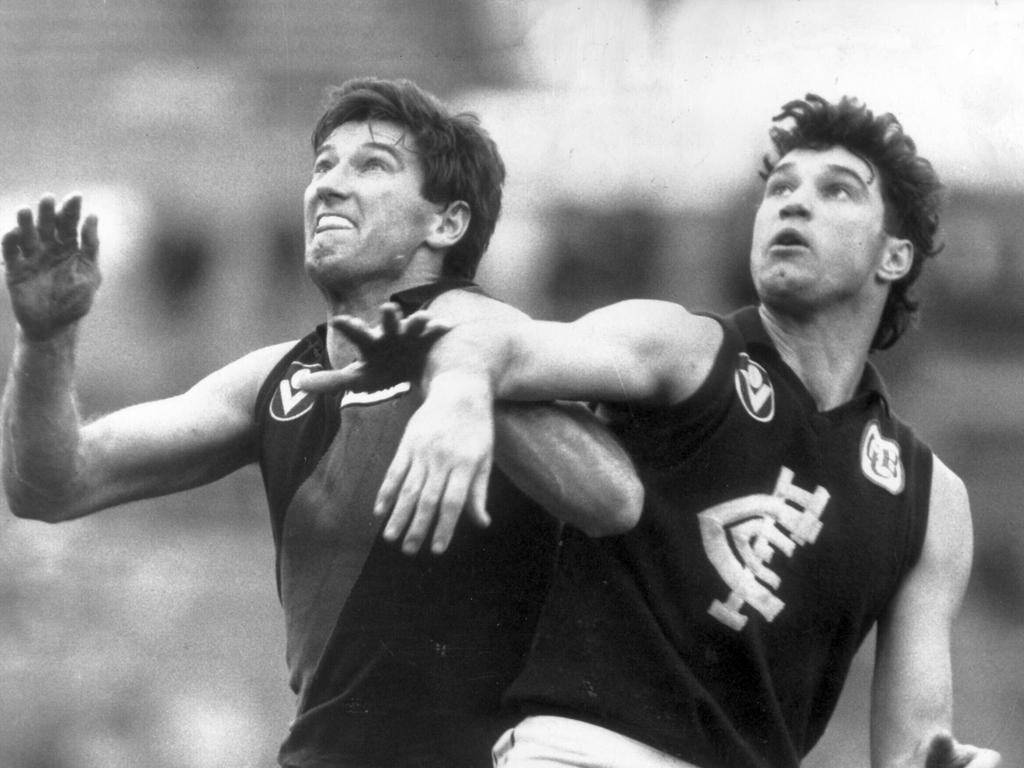
“Don Scott (Hawthorn) kicked me in the ankle just to say hello,” Madden tell CODE Sports.
“‘Crackers’ (Peter) Keenan (Melbourne, North Melbourne and Essendon) stomped the ground like a bull at the centre bounce. Jeff Sarau (St Kilda) punched, headbutted, kicked and kneed me and then said come for a beer after the game. It was never personal, it’s just what rucks did.”
Thankfully these days aren’t quite as violent as the time Madden roamed Melbourne’s suburban grounds, but the attrition rate on the game’s big men is arguably more severe than ever.
Knee injuries are the bane of modern day ruckmen with the posterior cruciate ligament (PCL) the main offender.
Last year Carlton’s Marc Pittonet and Collingwood’s (now Melbourne’s) Brodie Grundy both suffered serious PCL injuries in the same round.
Max Gawn’s knee problems this year weren’t with his PCL. But the injury remains the most common problem facing ruckmen and its greatest topic of debate, mostly surrounding the centre bounce.

Goldstein makes the case for the bounce being retained as a way to avoid injury.
“I’d like to keep the ball from being bounced,” Goldstein says.
“I have concerns about the possibility of throwing up the ball at centre bounces and stoppages and what it means for ruck injuries. It would present a lot more opportunity for more PCL injuries if the ball is thrown up all the time.
“The great thing about the bounce is it’s so variable and it’s hard to adjust. Players also jump from different positions with the bounce. Throwing the ball up would make it very predictable and it makes it an advantage for the taller ruckmen because it’s more of a jump ball situation. Throwing the ball up will make ruck craft different if they throw it up and will take away from that element of the game.”
The ‘craft’ element Goldstein talks about is lost on many.
A lot of fans see rucks as the dinosaurs of the game lumbering around bashing into each other.
The balance for the game’s rule makers is not to make them extinct by taking too much away from the combative nature of the position.
Madden suggests taking a step backwards with the rules may be the way forward and improve the spectacle.

“When I started there was no line and no circle, maybe that is the way to go,” Madden says.
“You take the line out, make the circle smaller, the rucks start outside the circle and you can run from any direction. That makes it very interesting. You can run straight at the goal and hit it long or run towards the other goal and hit it behind your head and make it an art form. Rucks can stand alongside each other, have their backs to goal or whatever but they still have to move to the ball and you instantly have less knees hitting each other and less posterior cruciate ligament injuries.
“If you watch Dempsey, Nicholls and Farmer, there’s a whole lot more leaping and better direction on the ball with the hit outs.”
The AFL has been trying to save ruckmen for decades and implemented a second centre circle, 10 metres in diameter, in 2005 to reduce their run ups and consequently PCL injuries.
It was a resounding success. Dr John Orchard and Dr Hugh Seward found in their 2009 study for ‘The British Journal of Sports Medicine’ that PCL injuries dropped dramatically after the rule was introduced.
Yet ruckmen continue to get hurt and on current projections it could be 30 years before another Todd Goldstein reaches the triple century of games.
Max Gawn and Brodie Grundy, the picks of the current bunch, are 31 and 29 and have played 184 and 183 games respectively.
Other notables are Toby Nankervis (125 games, 28 years old), Nic Naitanui (213, 32), Jarrod Witts (148, 30) and Rhys Stanley (187, 32).

Arguably the best two rucks of the last three decades Dean Cox (290, 33 years old at retirement) and Aaron Sandilands (271, 36) came closest but if they couldn’t reach the mark what hope do the current crop of young talent?
There are some very good young rucks including Sam Draper, Rohan Marshall, Tim English, Luke Jackson and Sean Darcy to name a few. It would be great to see one or more of them follow Goldstein into the 300 club.
Nine notable rucks to play 300 VFL/AFL
Simon Madden, Essendon: 378 games (1974-92)
Justin Madden, Essendon and Carlton: 332 games (1980-96)
Gary Dempsey, Footscray and North Melbourne: 329 games (1967-84)
John Nicholls, Carlton: 328 games (1957-74)
Barry Round, Footscray, Sydney and Williamstown: 328 games (1967-85)
Don Scott, Hawthorn: 302 games (1967-81)
Len Thompson, Collingwood, South Melbourne and Fitzroy – 301 games (1965-1980)
John ‘Sam’ Newman, Geelong: 300 games (1964-80)
Todd Goldstein, North Melbourne: 300 games (2008-23)
Other key achievers in ruck history
Peter Carey, Glenelg: 423 games (1971-88)
Graham ‘Polly’ Farmer, East Perth, Geelong and West Perth: 356 games (1953-71)
Dean Cox, West Coast: 290 games (2001-14)
Aaron Sandilands, Fremantle: 271 games (2003-19)

What‘s Weston-Turner’s fate? The draft bluffing game over ex-No.1

No trades, no worries for Crows great even after finals bashings

‘Weak c***’: Ex-Roos recruiter attempted suicide after alleged bullying

SuperCoach sneak peek: Six essential 2026 prices revealed

AFLW Phantom Draft: How the top 20 picks could fall, when bids land
