
CODE Sports Investigations: Wendell Sailor reveals why code-hopping makes sense for Joseph-Aukuso Suaalii but not for Payne Haas
Wendell Sailor knows all about the pressure and criticism that comes with code-hopping. He reveals why Joseph-Aukuso Suaalii is making the right call – but has a warning for Payne Haas.
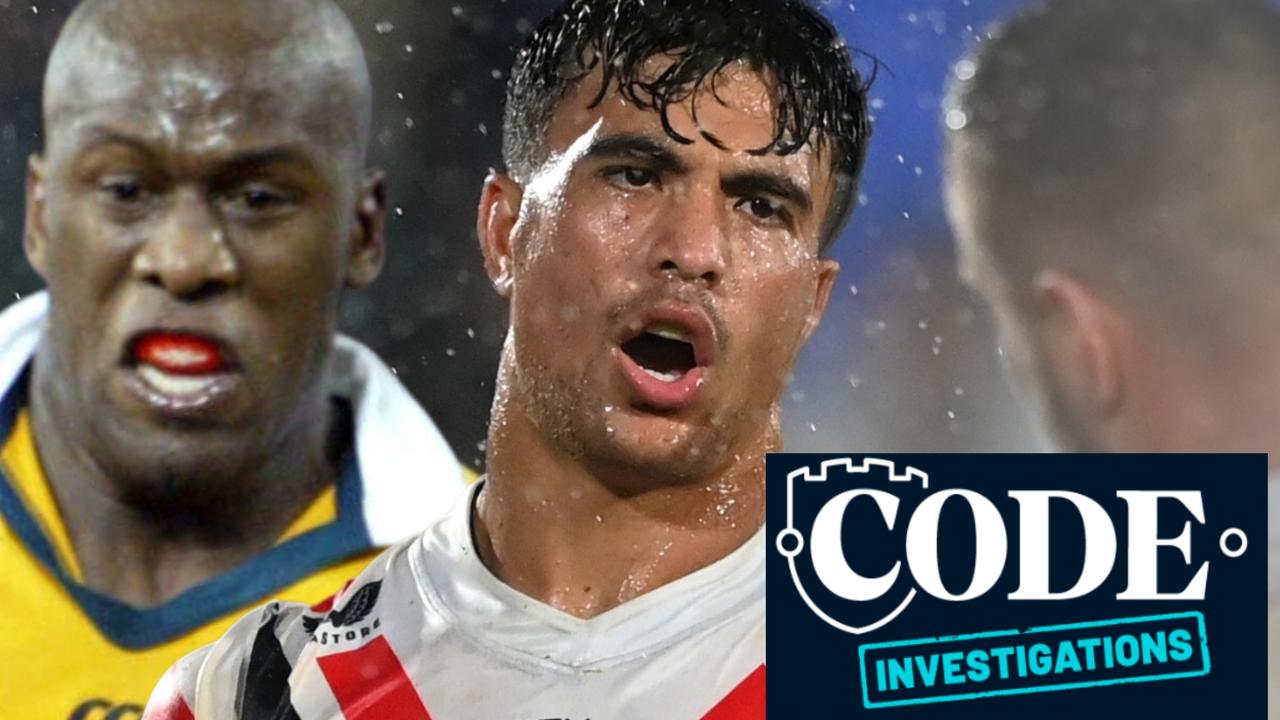
Code-hopping pioneer Wendell Sailor has backed Joseph-Aukuso Suaalii’s decision to quit the NRL and switch to rugby, telling the gifted teenager nothing matches the experience of playing on the global stage.
A legend who played at the highest level in both codes, Sailor told CODE Sports he expects more NRL stars will soon follow Suaalii in defecting to rugby because the combination of better pay and the lure of appearing in a home World Cup was too good an opportunity to turn down.
But Sailor did add a cautionary warning to any NRL forwards thinking about going over with reports Brisbane Broncos’ enforcer Payne Haas has been approached.
Though it’s highly unlikely Haas will change codes because league props invariably struggle with the technical aspects of union’s competitive scrums and lineouts, Sailor’s advice for him is to stay put regardless.
“We only have a short time in sport so I think you‘ve got to do the best by yourself and your family because a lot of clubs and a lot of teams just do the best for themselves,” Sailor said.
“So whether players switch or don‘t switch, it’s up to them.
“But I want Payne Haas to stay in rugby league. If rugby union gets him, good luck to them but I think he‘d be a waste in union.”
Like Suaalii, Sailor copped plenty of flak when he decided to jump ship in a blaze of publicity two decades ago.

Sailor had already scaled the heights in rugby league - winning four premierships with the Brisbane Broncos, two State of Origin series with Queensland and a rugby league World Cup with the Kangaroos - but gave it up because rugby offered him a unique challenge.
“The big thing for me was I grew up with Cathy Freeman so when I watched her win at the Olympics in 2000 and the Wallabies had just won the World Cup in 1999, I just thought to myself, ‘imagine playing the World Cup in your home country and winning it?” Sailor said.
“I knew the Wallabies were a fair squad at that time - they had (Toutai) Kefu, (George) Gregan, (Stephen) Larkham, (Stirling (Mortlock), George Smith, all these guys, so I didn‘t know if I was going to be good enough to be in that 22 but I just thought it was worth the risk.
“Even though I was paid handsomely, there were no guarantees by Eddie Jones.”
A natural showman, Sailor was an instant hit in rugby, helping draw record crowds and eyeballs to the Wallabies with his famous catchphrase: ‘Dell sells, so I’ll make those turnstiles swing baby.”
Unlike today, the Wallabies were the biggest drawcard in Australian sport at the time, having won the World Cup for the second time in 1999 and boasting a team jam packed with household names, including fellow league imports Mat Rogers and Lote Tuqiri.
All three were selected for the Wallabies and started in the 2003 World Cup final, which Australia lost to England in extra-time.
“Not for a minute do I regret it,” Sailor said.
“I played 37 Tests for the Wallabies and I got to see the world. I got to play the All Blacks, I got to play in South Africa, I got to play France, Italy, Ireland all those teams.
“You can‘t buy that, which is why I encourage all players to do whatever they feel because it’s their bodies and their mums and dads who brought them through the junior sporting systems.”

Although he was a success story, it doesn’t start or end well for Sailor.
There were plenty of people in rugby who opposed his signing from the outset and his rugby career ended in 2006 when he received a two-year ban after testing positive for cocaine.
“We brought something to rugby union. We raised the standards in the way that we trained but, obviously being league boys, we liked to have a good time as well,” Sailor said.
“So we taught them that too so some of the rugby boys would say ‘c’mon, let’s get rugby league drunk tonight.’
“At that time, there were obviously some fans saying ‘why are we buying these mungos’ but we‘ve got thick skins, we used to laugh about it.
“Some of it was a bit nasty. Me and David Campese went head to head a few times.
“He was saying Sailor hasn‘t got the skills to be a rugby player because he was trying to sign me to bring me over so I said ’David Campese was a great rugby player, but I’ll treat him like a doormat.
“I wasn‘t being disrespectful but obviously I’m not a shrinking violet.
“Some of the other rugby players who were contracted were asking ‘why are you buying these guys when we were established and came through the systems.
“But I loved every minute of it and I got to play against the best players in the world, like Richie McCaw.
“I didn‘t do the right things by rugby. But you know what? That made me appreciate what I had so that’s why I think players should be free to choose what they want to do.”
Sailor still follows both codes and hopes for a truce in the war of words that has erupted since Suaalii announced he was going to rugby, saying it was unfair on the players.
“I saw Phil Gould sort of went at him, but what the critics misunderstand is that this kid is putting his body on the line,” Sailor said.

“You can‘t play forever so I encourage players to do what they want to do and get what they get because it’s up to them and their families.
“And the thing you have to understand with Joseph is that he mightn‘t be doing it just for himself, he might be doing it for his family as well.
“With a lot of the indigenous and Islander cultures when you sort of make it, your family makes it so when Phil and other experts have their say, they’ve got to understand it might not just be about the money or that opportunity, because maybe it‘s for the whole family.”
While the current state of Australian rugby is a far cry from what it was when he was scoring tries on the wing, Sailor is confident the Wallabies’ fortunes are about to turn around - thanks to the return of his former coach.
“Eddie‘s changed the game up again. Rugby union has got Eddie at the right time again,” Sailor said.
“I‘ve got no doubt we can get to the semi-finals. I’m not saying that they will win it but I’ve got no doubt that we’ve got the talented players and Eddie has this knack in the first couple of years, just making everyone want to play for one another.
“I was talking to Anthony Seibold and told him ‘in Eddie we trust.’
“I‘ve rung Eddie a few times. Last year when he had a go at that fan, I loved that.
“I‘m a fan of the game and I just love the way Eddie just does things his way. Have a look at the press since they bought him. He’s just getting rugby back in the papers again.”

‘Worthless’: Sports clubs’ sobering child safety warning

‘Every second day’: Supplement program that sank Dons revealed
Bubbles, blood and blagging: Inside the Rennie Ellis renaissance
Sports warned: Address gender equality or lose funding

Rebels with a national cause: The dinner that shook footy
