
Catches win matches: The tactical evolution of fielding thanks to T20 cricket
Spectacular catches have always been a feature of cricket, but adapting to T20 has unveiled a host of new fielding tactics in training and during games, writes DANIEL CHERNY.


As a player, they were the types of days Simon Helmot used to hate. And there have been a lot of them in Melbourne lately. Wet, but not wet enough to stop fielding training. The late John Scholes, in charge of Fitzroy-Doncaster before his days as Victorian coach, relished the chance to test his players in the wet. Helmot, who would later follow in Scholes’ footsteps, coaching around the world, took note.
“He looked at training as an opportunity to improve. We used to be scared on a wet day, because we knew we’d be running and we’d be fielding,” Helmot says.
But in what was an example of the overload theory of skill acquisition, fielding in matches felt easy.
Watching Helmot guide his Melbourne Renegades women through a fielding session shows that he has drawn inspiration from the late Scholes.
On a slippery Wednesday at Albert Park’s Harry Trott Oval, during a week in which La Nina would wipe out three World Cup matches at the MCG, Helmot encourages a group of around 10 players through what he says was a particularly intense session.

Fitting for conditions conducive to swimming, the drills take a freestyle vibe. There is organisation, but aside from the odd stump and Helmot’s bat, there is no equipment.
“No cones, no lines. My coaching philosophy, which is probably shared by many, with fielding, is … take away the cones, it’s got to be game-like or game sense activities,” Helmot says.
“Fielding can be messy. So don’t have, ‘Oh run from this cone to that cone.’ That doesn’t happen in a game. Glenn Maxwell has to run as fast as he possibly can, with Mitch Marsh running from the other side.”
Helmot is relatively new to coaching women, having largely built his reputation as a globetrotting men’s coach. But his sessions are largely the same regardless of the gender of the participant.
“The key principles are the same. At times the level of intensity [varies],” he says.
“When you have sessions where the ball’s constantly just out of reach or the ball’s going really fast or really high, it’s a learning opportunity for males and females to learn about themselves.”

A team pursuit
One striking element of this session is the focus on teamwork. Cricket is largely an individual pursuit played in a team framework but here the Renegades are working together. Like animals heading to Noah’s Arc – another neat tie into the conditions – the Renegades players are sent on their way for a series of outfield catches. These aren’t gimmes, Helmot is whacking the ball hard and forcing the players to sprint for repeat efforts.
If there is one thing which Helmot, a regular on the franchise circuit, and former Australian opener and fielding coach Greg Blewett says has changed in attitudes towards fielding, it is the idea of players working together.
It is a legitimate tactic for batters to look to land the ball in space between fielders on the leg side. Working out who will take first bite at the cherry, and whether another fielder can provide support, becomes important.
“Running in numbers in T20 cricket is everything,” Helmot says.
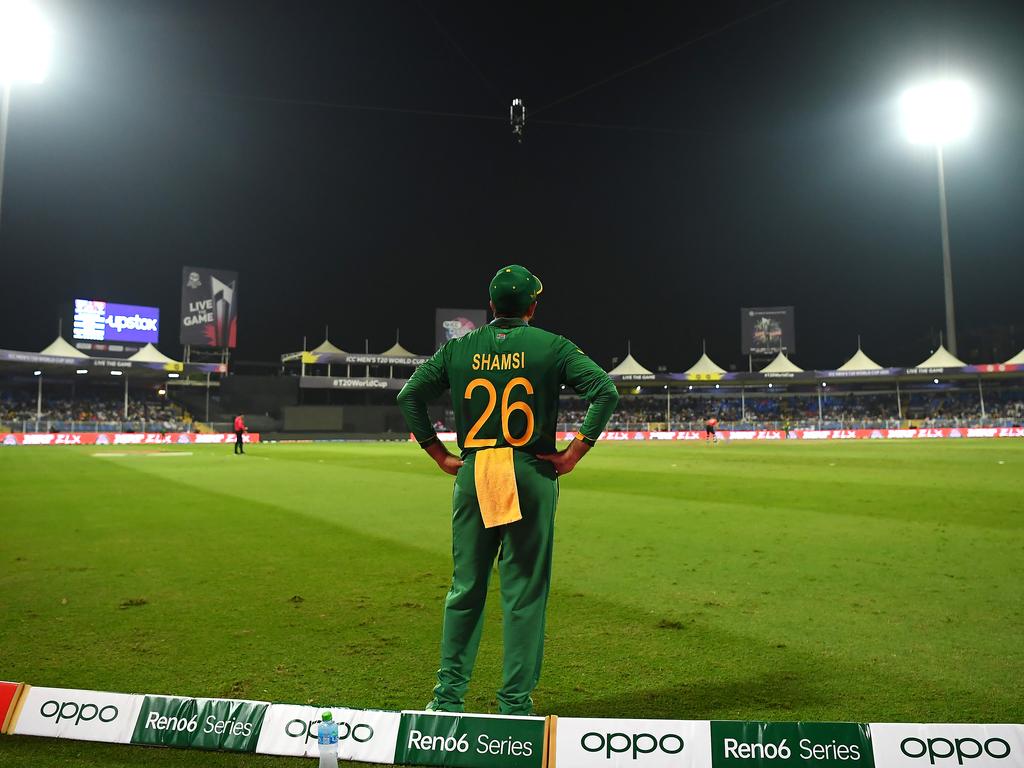
Blewett elaborates: “If you can get multiple people around it without putting the catcher off, and if there’s a ricochet or a fumble they are there to mop it up.”
It stands to reason that the more a group of fielders train and play together, the better they get at working in unison, knowing how to help each other but stay out of the way when suitable. Helmot cites the example of Ricky Ponting, Michael Clarke and the tragically departed Andrew Symonds ready to pounce in the infield for Australia during the golden era of the 2000s.
Beyond the boundary
Ponting features in another story Blewett uses to illustrate the fielding evolution, but not in the way you’d probably expect.
Among the most dramatic changes to fielding is the way players navigate the boundary. In part that is because the boundary itself has changed substantially. Historically, the boundary was literally the boundary of the playing surface, the gutter and or fence of an oval. But as limited-overs cricket surged in popularity, players began to get more desperate to stop runs in the outfield.
The slide became ubiquitous, and Ponting was indirectly responsible for the eradication of the fence as a boundary. Because of its relatively small dimensions, the SCG had been among the last Australian venues at which a rope inside the fence was used.

In successive summers however, Brad Young (knee) and then Ponting (ankle) hurt themselves sliding into hoardings in pursuit of the ball. The rope became almost universal, but has itself been superseded. Because no piece of real estate is sacrosanct in cricket when met with the force of capitalism, the rope has morphed into what is colloquially known as “the Toblerone”, a series of triangular prisms serving the dual purpose of being a boundary marker and space for sponsors to splash their names.
Blewett had experienced first-hand the associated challenges of chasing balls in the pre-rope era, his golfing buddy Ponting serving as antagonist.
“We used to slide into the fence,” Blewett says.
“I remember getting my foot stuck at Adelaide Oval. Ricky Ponting was batting, I think I turned a two into a five because I couldn’t get my foot out from underneath the fence.”

There have been quantum leaps on the boundary since the 1990s. Most spectacular is how players now routinely reach and or step over the Toblerone in a bid to keep the ball alive while off-balance, tossing the ball up to give them extra time to complete the catch inside the field of play.
When Adam Voges pulled out the trick during a Twenty20 international at the SCG in early 2009 – overcoming a stumble on the Toblerone in doing so – it felt like he had entered a cheat code.
This would have been almost impossible when the fence doubled as the boundary, but is now close to a prerequisite for fielding on the boundary as a professional.
“Everyone would be practising that now. That’s a must-have skill,” Blewett says.
And the catch doesn’t even need to be taken to make a sizeable difference. So much of work on the boundary now is about stopping a six, even to turn it into a one, two or three. Ireland’s Barry McCarthy provided a stunning example of this genre during his side’s loss to Australia earlier in the T20 World Cup, launching himself almost horizontally to prevent what would have been a six, and throwing the ball back into the field of play mid-air before crashing to ground.

What makes a great fielder?
The hosts have been on the end of a couple of extraordinary fielding efforts during their title defence. Before McCarthy’s fly was that of New Zealand’s Glenn Phillips, who leapt like he was on the starting blocks of an Olympic swimming final to remove Marcus Stoinis during the Super 12 opener at the SCG.
Helmot worked up close with Phillips in the Indian Premier League, so wasn’t shocked by the Blacks Caps batter’s work in the outfield.
“That Glenn Phillips can do 11 flat,” Helmot says.
“We had him at the Sunrisers this year. Unfortunately he never got a game, the poor guy, but he never changed his attitude.
“That catch he took the other day … unbelievable commitment. He created, he didn’t wait.”

Helmot, 50, says the essence of what is capable in the field has been around for decades. He cites the catching of Bruce Laird, John Dyson, Kim Hughes and Bruce Yardley in the 1980s as proof that breathtaking feats are not new.
“There’s always been the capacity and the skill, I think we’re seeing it more often. That’s because the expectation is higher that we get to more balls,” Helmot says.
He says fielding can be encapsulated into four parts: athleticism, skill, attitude/character, and experience. David Warner is an example of a player who possesses all four attributes in the field; Helmot an unabashed admirer of Warner’s determination to chase everything to the death in the outfield.
Superhuman Phillips!
— ICC (@ICC) October 22, 2022
We can reveal that this catch from Glenn Phillips is one of the moments that could be featured in your @0xFanCraze Crictos of the Game packs from Australia v New Zealand.
Grab your pack from https://t.co/8TpUHbQQaa to own iconic moments from every game. pic.twitter.com/VCDkdqmW3m
The aphorism that “catches win matches” is drummed into every junior cricketer, and with good reason. In T20 cricket, where the margins tend to be small, interventions in the field hold disproportionate weight.
Helmot mentions a match during his time coaching the Renegades men. It was the summer of 2012-13, and Faf du Plessis had just held Australia at bay for almost eight hours to save the Adelaide Test. He was called upon to play one game for the Renegades, who had a short-term overseas player vacancy.
As Aaron Finch blasted a ton, du Plessis scratched his way to 14 from 17 balls. But his go-slow with the willow was more than offset by brilliance in the field.
“In the field, he threw the stumps down to get Hodge out, and he catches Cameron White out at deep mid-wicket. That changed the game,” Helmot says.

As a coach in franchise cricket, Helmot frequently plays the role of recruiter. And he says that when it comes to drafts and auctions, a player’s ability in the field can end up being worth millions of rupees.
“When you’re comparing two players, or three players, for a spot, and when you go through their categories of, ‘What’s their skillset, where can they play the game?’ Then maybe the second or third question is, ‘Where do they field?’ If so-and-so’s a brilliant fielder but so-and-so’s a bit slow and unreliable, then that’s the casting vote,” Helmot says.
Blewett was Australia’s fielding coach for three years in the era of his long-time South Australian partner Darren Lehmann.
“The fast bowlers are so much more athletic I think now. Some of them are the better fielders,” he says.
“Mitchell Starc and Pat Cummins are fantastic.”
The final frontier
These days working several media roles across radio and television, Blewett says the training in fielding has come a long way, but adds that in his experience cricketers still prefer to keep things relatively conventional.
“In my time as coach I found the more stuff I tried to introduce, I got more of a kick back I think from the players,” Blewett says.
“The training was very specific in terms of roles for each guy. That was a big change from my playing days, we all did the same thing, apart from slips catching.
“It’s a lot of flat balls at around the ring distance. Same with high balls. And then you head out from there I suppose. The other thing with training is trying to train how they are going to play.”

And yet for all the inroads made, both Helmot and Blewett share a view on one aspect of fielding which retains enormous scope for improvement.
“Something that’s always been talked about … throwing left and right handed. It’d still be something I’d love to see and explore,” Helmot says.
“With the girls’ game I think there’s a great capacity, because we’re still developing athletes, we’re still developing our skills.”
Blewett echoes those sentiments.
“It’s been said for a long time now, but if you can go the double side. That’s the next thing. That’s been a slow burn now for a while. I haven’t seen too many guys that are able to throw just as powerfully on both sides,” Blewett says.
“I [also] still think your stock-standard catching probably hasn’t improved as much as the athletic side of fielding.”

In town for the Ashes? These are the best Adelaide pubs to visit

Seifert’s historic century as Renegades hammer the Heat

NSW cricketer banned after allegedly sending nude photos

Why Lyon doesn’t have a ‘point to prove’ as Test recall looms

Smith illness threatens Aussie line-up chaos as Poms ignore Bashir
