
T20 World Cup spinner James Muirhead had his promising international career ended by injuries, and it almost cost him everything
Four years after representing Australia at the T20 World Cup, James Muirhead found himself in the darkest of places. Daniel Cherny reports.

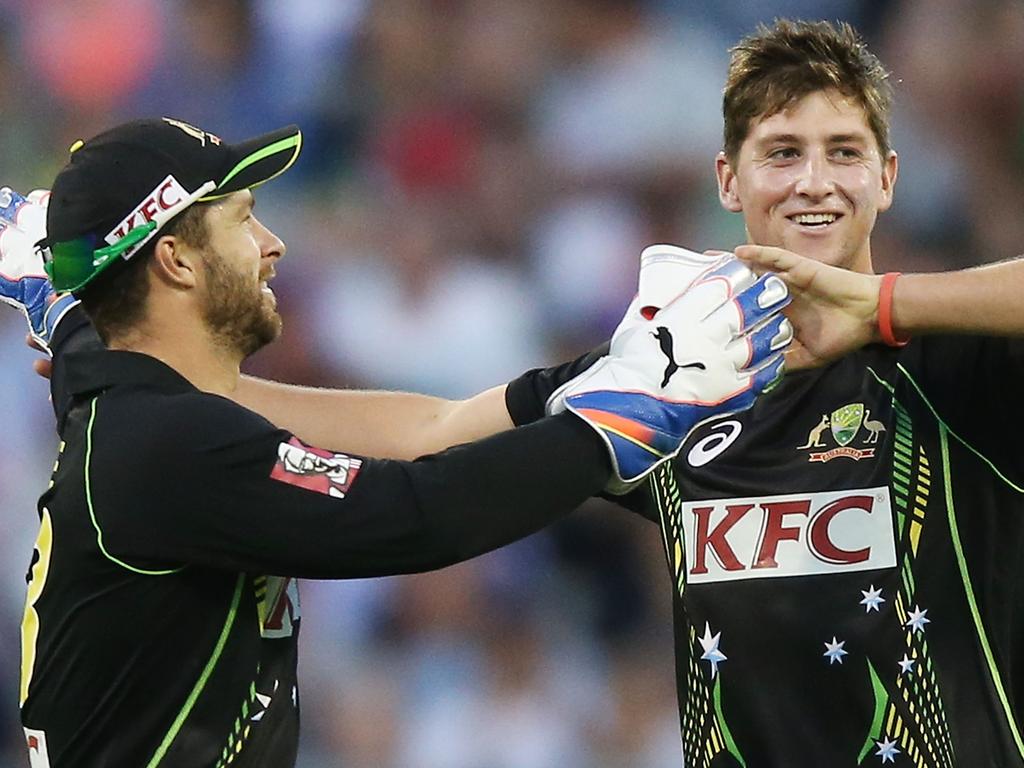
Until now, only a handful of people in James Muirhead’s closest circles knew about the time he sat in his car on Altona boat ramp, and thought of his mother.
It was the middle of 2018 and Muirhead was lost. Barely four years earlier he had played cricket for his country. But Victoria hadn’t renewed his contract, and Muirhead, in his mid 20s, didn’t know where he would head next. In his mind, he didn’t know if life was worth living.
“The lowest point was when I was living by myself,” recalls Muirhead, more than three years on from what could have been a tragic tale.
“It was not long after I lost my Cricket Victoria contract. I was sitting in my car by myself, not knowing what I was going to do. I’d never worked a day in my life. Cricket was everything to me and it had just all of a sudden been taken away. I was sitting out on Altona boat ramp really wanting to drive my car into the water.”
Thankfully, Muirhead resisted that urge. What stopped him from pressing the accelerator as hard as he could?
“I couldn’t picture my mum seeing me not being there.”
*****

At 20, James Muirhead was Australian cricket’s next big thing.
Leg-spin is renowned as the hardest craft to master in cricket, and yet Muirhead was a prodigy. After soaring through the ranks at Premier Cricket Club St Kilda, Muirhead had played just two first-class matches and four professional Twenty20 games when he was named out of the blue in Australia’s T20 squad for a series against England in early 2014.
On a freezing night in Hobart he made his debut, finishing with 1-34 from four overs including the wicket of Tim Bresnan. Soon he was on the plane to South Africa for a tour ahead of the World T20 in Bangladesh. In the Rainbow Nation he would be mentored by Shane Warne - undertaking a brief stint coaching with the national side. The parallels with Warne were clear: a big-turning, raw leggie from St Kilda playing for Australia on the back of very little domestic cricket.

Muirhead went to and then played the World T20 (these days known as the T20 World Cup), where his wickets included Chris Gayle and Virat Kohli.
But what seemed like the beginning of a bright career was, in truth, the beginning of the end.
If there is one body part a leg-spinner can least afford to injure, it is his bowling wrist.
Muirhead first realised something was wrong when he bowled a couple of full tosses to Dwayne Bravo.
“I thought, ‘Woah, what was that?” Muirhead recalls. “It’s very hard to explain what it feels like. It’s pins and needles in my bowling finger, spinning finger.
“It’s like a nerve sensation. While that’s going, I can’t bowl.”
Muirhead returned home, and tried to push through the injury. But ultimately an operation was deemed the best course of action.
He was never the same.
“The last five years of my career were very frustrating,” he said. “I had surgery on my bowling wrist, probably about 12 months after my last game for Australia.
“I could never bowl the ball the same. I could never get the revolutions like I used to. It was just so different. And the pain was still there. I pushed through and I kept trying, but I could never overcome it.”
Muirhead was traded from the Melbourne Stars to the Perth Scorchers, a straight swap for fellow St Kilda product and brief international representative Michael Beer.

Despite being unable to crack it for a regular game in a team featuring Brad Hogg and Ashton Agar, Muirhead enjoyed his time in Western Australia, where he was coached by Justin Langer.
Muirhead will not hear a bad word about the now-Australian coach.
“Being able to play under the guidance of Justin Langer, which is one of the best things that I was fortunate enough to do, I think he’s the best coach in Australia, in the way he goes about his business,” he says.
“It’s hard, but it’s a winning formula. He demands perfection, but if you give him that perfection, he’ll treat you like a son. The Australian public have no idea of the person he is.”
In his home state though, things weren’t as happy for Muirhead.
Muirhead plugged away in Fawad Ahmed’s shadow. He got on well with Ahmed, but says that egos within the Victorian squad could make life difficult.
“I always felt like an outsider with Victoria. Never in WA, I always felt accepted over there,” Muirhead says. “Perth Scorchers guys I still talk to. I haven’t heard from anyone but Jake Reed and Travis Dean since leaving Victoria.
“My personality obviously didn’t fit the group, and I was probably not honest enough with the group about my struggles. It’s just the way it is.”
Once supremely confident in his ability, Muirhead’s self-belief slipped away as his body failed him.
“I was literally frightened coming to games, not sure what was going to happen,” he recalls.
More than the doubts, more than the injury, more even than a perceived lack of support from Victoria, the biggest problem was Muirhead shutting off others.

“I didn’t seek help, I just stuck to myself, kept quiet, which is not the best thing to do,” he says. “I was in a lonely place, that’s for sure. There were a fair few friends that I did lose because I was very quiet about my issues, and I was embarrassed about people knowing what I was going through.
“I pushed them aside, and I ignored them. They were trying to help me but I tried to avoid everyone trying to help me.”
From that terrifyingly low moment in his car, Muirhead took a season away from cricket before making a comeback with Footscray.
But the same issues kept coming back.
“I wanted to get away from anything to do with cricket,” he says. “Any friends that I had to do with cricket I just pushed away, because it reminded me of the past that I wanted to forget about.
“If I had my time again, I would have trusted in people, and listened, and not tried to do things by myself because ultimately that’s what really hurt me in the long run.
“I am slowly trying to reach out to certain individuals. It’s very hard to do this, because it just feels like I’ve let them down. I hope they forgive me, because ultimately they were trying to forgive me more than anything else, and I just want to apologise to people for not being honest about my struggles.”
Slowly but surely, he has got his life back on track. He is working as an account manager at Strap and Wrap industrial packaging and doing a bit of spin coaching at Maribyrnong Sports Academy.
When Muirhead had first looked for a job, he had sought out a familiar name for help.
“My first job outside of cricket was in recruitment,” he says. “And I rang Justin when he was in England coaching Australia asking if he could be a reference for the job. And he said, ‘Absolutely Jimmy,’ he even picked up the phone early one morning in England and became a job reference for myself. That shows the calibre of person he was because I didn’t know who else I could trust.”

Support has also come from his dad, his older brother Michael, former St Kilda teammate Alex Bychkov, and a handful of friends outside cricket.
Muirhead has come to peace with his lot. Despite playing for Australia, his proudest moment came when earning his first XI cap at St Kilda, and seeing his name on an honour board dating back to 1855. He says that without St Kilda captain and former Victorian batter Graeme Rummans’ support, he would never have achieved anything in cricket.
The challenge now for Muirhead is rebuilding bridges. He accepts he was tough to be around during the depths of his struggles.
“It’s only the last six to eight months that I’ve opened up about my struggles, and that’s why I wanted to do this interview,” he says. “I’ve resisted doing it in the past, because I’ve never wanted anyone to know.
“But now I’m trying to come to terms with that, to celebrate what I was able to achieve. It wasn’t how long I wanted it to be, but you’ve got to celebrate whatever you get out of it.”
His message to others is simple.
“I want players now, if they read this to really feel like it’s OK to not be OK,” he says.
“You never know when your last good time will be on the cricket field.
“I want to voice my story finally, get it off my chest, so people out there can understand. I know I’m not the only person out there who feels that way.
“Life’s hard, but life’s great. There’s a lot of ups and downs, it doesn’t matter what you’re doing for a living. There’s people around you to help. It’s better to speak up than not to speak up.”
If you or someone you know is impacted by depression, or experiencing suicidal thoughts or feelings, contact the Lifeline crisis line on 13 11 14. In an emergency, call 000.

In town for the Ashes? These are the best Adelaide pubs to visit

Seifert’s historic century as Renegades hammer the Heat

NSW cricketer banned after allegedly sending nude photos

Why Lyon doesn’t have a ‘point to prove’ as Test recall looms

Smith illness threatens Aussie line-up chaos as Poms ignore Bashir
