
Barcelona’s departing midfield great Sergio Busquets seduced minds and defied extinction
The greatest generation ever wrought nearly missed its linchpin, yet Sergio Busquets overcame rejection to build a Barcelona career nearly unrivalled in this era, writes JAMES GHEERBRANT.
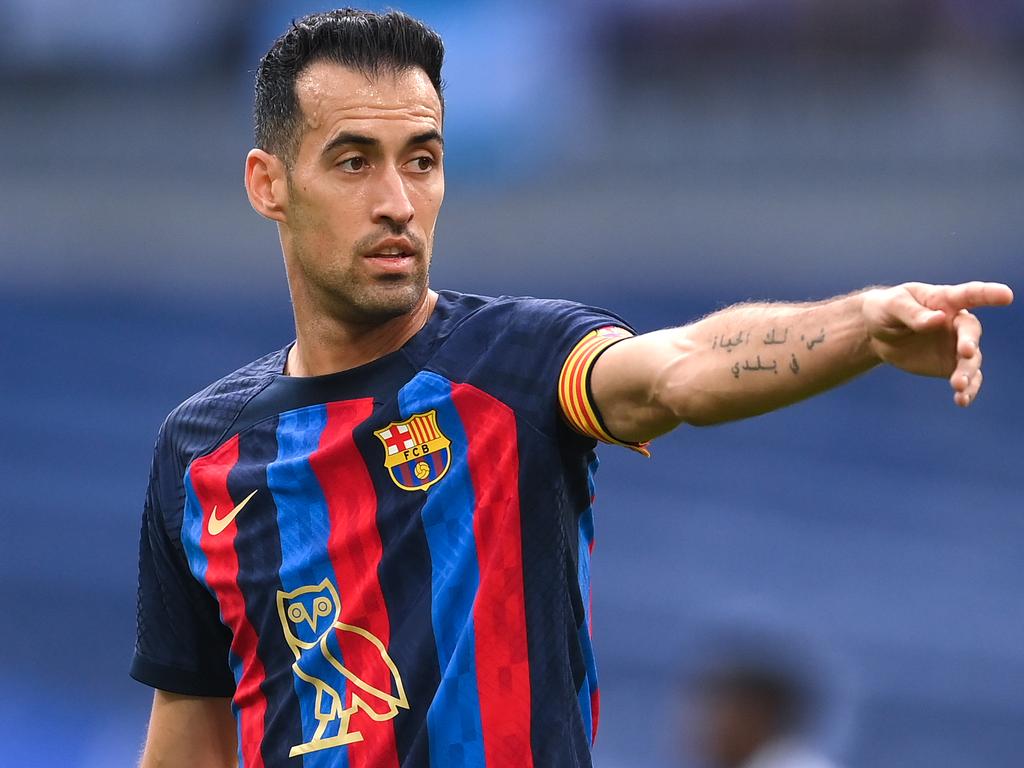
The greatest generation ever wrought nearly missed its linchpin. Unlike his revered contemporaries, Lionel Messi, Xavi and Andres Iniesta, Sergio Busquets did not spend his childhood and early adolescence in La Masia, the Barcelona academy. He was rejected at his early trials and spent years playing for the youth teams of less-illustrious local clubs, though his Barcelona credentials were in some ways the most impeccable of all: his father, Carles, had been a Barcelona goalkeeper of long service.
When he was finally welcomed into the cathedral, aged 17, it rapidly became clear that Barcelona had discovered a star. Johan Cruyff’s column for the Catalan paper El Periodico the day after Busquets made his La Liga debut at 20 in summer 2008, against Racing Santander, immediately distilled his brilliance: “Positionally, he already appears like a veteran … with the ball he makes the simple look difficult, moving the team up the pitch with one or two touches. Without the ball, another lesson – that of being in just the right position to intercept and recover the ball quickly.” The great Argentine manager, Cesar Luis Menotti, when he first saw Busquets play, telephoned a friend and said: “I’ve seen a player from an extinct species.”
And now, all these years later, the species nears its disappearance again. Busquets has announced that he will leave Barcelona at the end of this season, probably for some sunset sinecure in the Gulf. He will go down as one of the great players of his age and one of the best defensive midfielders of all time: not a footballer to quicken the pulse but one to seduce the mind, a figure of subtle mastery and devilment. For accomplishments, he has few equals: a world and European champion with Spain, thrice victor in the Champions League with Barcelona, not to mention the eight La Liga titles and the seven times he lifted the Copa del Rey.

Busquets was a crucial figure in Barcelona’s glory era under Pep Guardiola, an apotheosis of beautiful football. In possession, he was balletic and unruffled, the knot at the centre of that ever-shifting cat’s cradle of passes. He seldom broke into anything above a brisk jog, but in the angle and cadence of his passing, speed could be imparted and implicit. Off the ball, he had the quality of premonition, and a streak of vulpine cunning which was not always endearing.
He gained a reputation for tactical fouls, even a certain slyness, most memorably crystallised in the famous image of him peeking out from between his fingers having successfully got Thiago Motta sent off in the Champions League semi-final against Inter Milan in 2010. Arsene Wenger once said of Busquets, a little sanctimoniously, that “he has all the moral weaknesses that help in football”.
But even if he wasn’t always universally loved, to his teammates Busquets was indispensable, a warrior. “I have this mix of coming from the neighbourhood, of having played on the street, on dirt pitches, having no problem rolling up my sleeves if the game asks for it. And if you have to get down into the dirt, then do that too,” Busquets told El Pais before Euro 2020. “When there is trouble, Busquets will always be there,” Messi once said.
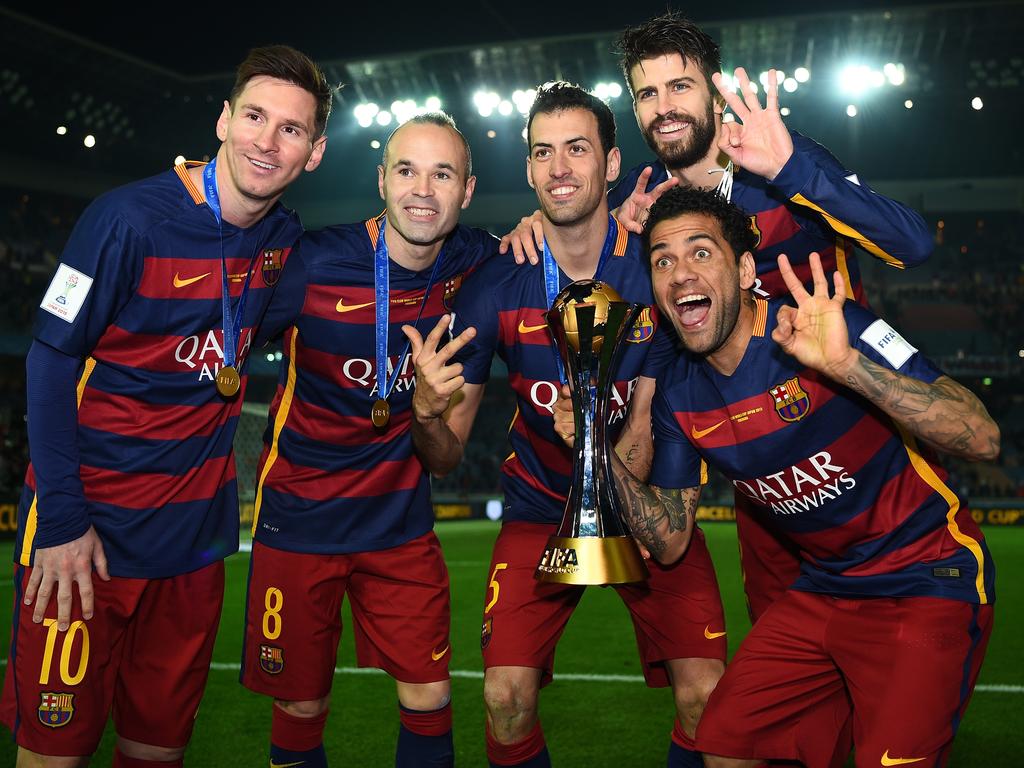
As a player, Busquets changed over the course of his long career. He has come to play a more influential role in Barcelona’s attack. He has, for example, contributed nine assists over the past three La Liga seasons; at the start of his career, it took him seven seasons to accrue nine assists. This season, he is averaging an exceptional 9.5 progressive passes (those which move the ball ten yards goalward or into the box) per 90 minutes, up from 6.6 just four seasons ago. His ability to find teammates in between the lines, often using his body shape to disguise his intentions, remains as good as ever.
But the other side of his game, that defensive disruption, has regressed. From 2015-16, when he won 2.4 tackles and made 2.1 interceptions per 90, his defensive output has been cut in half, dwindling to 1.1 tackles won and 1.0 interception this season. That’s hardly surprising: he is nearly 35, after all. But his twilight years at Barcelona have also been memorable for some porous performances, for the image of Busquets chasing back in vain, most notably in the 8-2 defeat by Bayern Munich in the 2020 Champions League quarter-finals.

Still, what a player, and what a career. Although the imperial age of Spanish football is always associated with prettiness, in the case of the national team that was only partly true. The 2010 World Cup triumph, in which Spain advanced through the knockout stages with a series of stately 1-0 victories, was built more on Busquets’ qualities: treasuring the ball, intuiting the counter, picking the moment. In making his final farewell from serious football, his timing, as ever, is probably right.
Originally published as Barcelona’s departing midfield great Sergio Busquets seduced minds and defied extinction

SuperCoach EPL: How to replace missing AFCON stars

Sydney football club mourns player killed in Bondi terror attack

The Tackle: Mata has last laugh over ‘embarrassing’ Wanderers

The Melbourne-born teen who has world football giants circling

Vergos ends drought with brace in original derby win
