
Ange Postecoglou’s coaching start at South Melbourne told of the EPL manager he would become
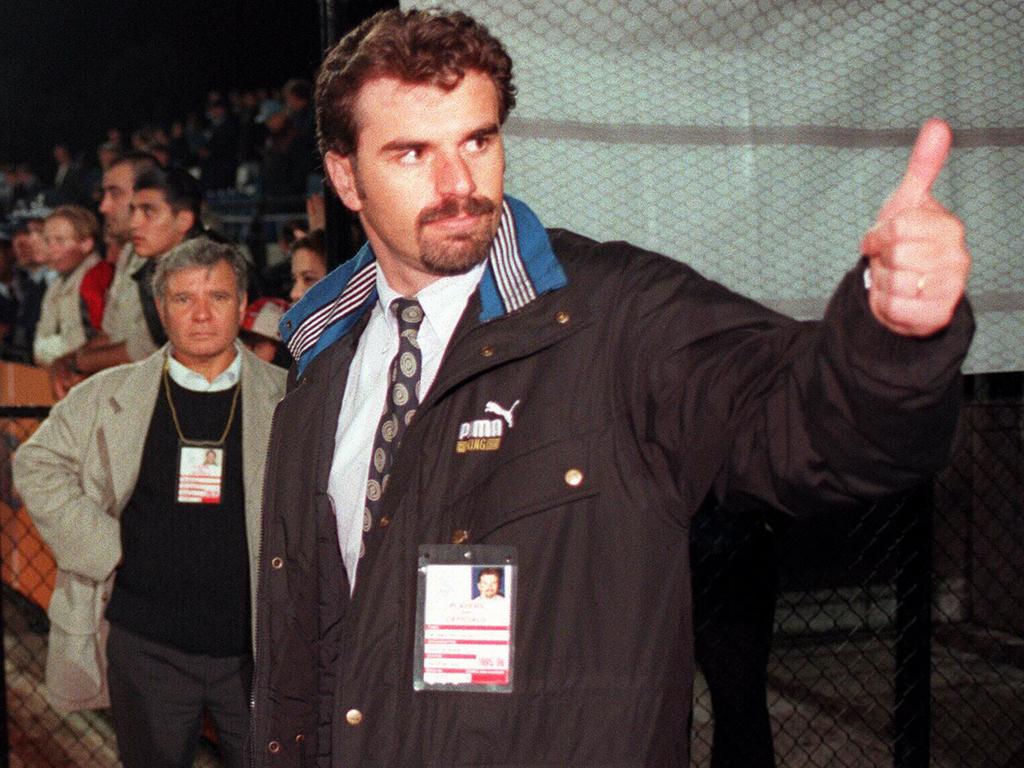
Ange Postecoglou was working in a bank when his first head coaching job arrived, at the expense of a legend. Soon after taking over South Melbourne, he ended a close friend’s career, writes ADAM PEACOCK.


Nearly three decades before Ange Postecoglou got the life-changing call about a job going in the English Premier League, he was working in a bank.
Westpac’s Clarendon St branch.
It was one of three jobs that Postecoglou had.
The bank job paid the bills, supplementing coaching at Melbourne Grammar, and his true love, assistant coaching at South Melbourne.
But South Melbourne, in April 1996, was in turmoil. Legendary coach Frank Arok was sacked at a board meeting.
The next morning, South Melbourne general manager Peter Filopoulos had some news for Postecoglou, but had to wait until Ange took his morning tea break.
Eventually he emerged.
‘Ange, Frank’s gone. You’re the new manager,’ Filopoulos told his friend.
With no emotion, Postecoglou responded with his customary, “Thanks big fella”, before giving Filopoulos a simple instruction.
“Tell the players, the staff, all come to the club tonight. Everyone has to be there, 6pm. Compulsory.”
And with that, Postecoglou celebrated by going back inside the bank to think about how to take a football team to the top.
*****
Could this former player, whose career ended with a bad knee injury at 27, turn South Melbourne’s fortunes around at age 31?
The South Melbourne board initially weren’t convinced, but that in itself was an achievement of miraculous proportions.
The board was made up of 16 people, mainly first-generation Greeks, who all had an opinion stronger than the next guy.
Filopoulos knew, though, that Postecoglou was the man.
Arok’s tenure ended after a disastrous 3-0 defeat away to Marconi in Sydney, and the former Socceroos coach knew what was coming as he slumped in his seat as the team bus chugged its way towards Sydney Airport.
The mood from the players told a lie. They were jovial, laughing and carrying on at the back of the bus.
Postecoglou, Arok’s assistant, snapped, marching to the front of the bus to grab the microphone and let rip.
“Hey guys, while you’re celebrating and joking,” Postecoglou fumed, “I just want to remind you what went on tonight.
“I’ve played for this club since under 8s, captained it to two championships. No team that I’ve been associated with has disgraced this jersey and this emblem like you blokes did tonight.”
The laughing stopped.

*****
After Arok’s sacking, South Melbourne under Ange won two of its last three games to see out the 1995-96 campaign.
Hopes were high after Postecoglou’s first full pre-season with the team but they stumbled early, failing to win in the first five games. The big, bloated board of 16 were unconvinced. Murmurs started that Postecoglou would be fired.
The sane ones held their nerve and Ange’s methods started to work. By the end of the season, South finished a respectable third.
Big decisions, though, were needed for the next step.

Postecoglou and Mike Petersen knew each other as kids. They came through the playing ranks together at South Melbourne and formed a close relationship.
Petersen, a 32-cap Socceroo, was a key player through the 1990s but by 1997, Postecoglou could see the end for his friend and told him that his career was over.
“At the time I was pretty shattered, but one thing that sticks in my mind was the care and compassion he delivered it with,” Petersen tells CODE Sports.
“Every decision was for the best of the team. He had a way of delivering it where you don’t take it personally, you always felt part of the team. Those things are important.”
Postecoglou softened the blow by making Petersen his assistant. The friendship lives on to this day.
But the episode changed Postecoglou and ever since, he’s maintained a personal distance from his players. Instead, he’s formed a way of connecting with them with motivational methods and clear instruction.
“He was captain at 21, 22 at the club,” Petersen says. “Then manager at 31. He always had those invisible, intangible qualities of leadership.”
Petersen can’t stop smiling this week, knowing what Tottenham Hotspur have gotten themselves.
“Proud? Past the word proud,” Petersen says.
“I find it remarkable how he’s navigated it. And playing football the fans love, picking up silverware on top of it!
“In awe at what he’s achieved. And what’s more, I believe Ange’s finest chapter is yet to be written.”

*****
Any player who has worked under Postecoglou will talk of one constant trait in how he prepares players.
Intensity.
These days, it’s all with the ball.
In those early South days, old-school methods also formed part of the Postecoglou philosophy.
Fausto de Amicis, a running machine of a defender, was poached by Postecoglou from rivals Melbourne Knights for the 1997-98 season. During pre-season, he wondered where the balls were.
“I was a typical whingeing Italian, ‘When we gonna kick a ball!’” De Amicis now laughs.
One evening, Postecoglou ordered the team to run Melbourne’s famous Tan running track for a time trial.
“I was cursing, saw they were taking times and told them you know where you can stick those times, who cares,” De Amicis says.
The team got back to its nearby home ground, Bob Jane Stadium (now Lakeside Stadium), to reveal the results.
De Amicis finished third and expected a bake from Postecoglou. Instead, that went to a teammate, a supremely gifted attacking player.


“I’m like he’s gunna bag the living daylights out of me. I was whingeing, abusive. He says I was third, then all of a sudden, he says, ‘AND YOU, GORAN LOZANOVSKI! Look where you are next to this guy who hasn’t stopped whingeing the whole time, swearing, complaining!’
“And Lozza is thinking, ‘What the f – k has it got to do with me?’ (Postecoglou continued): ‘At least (Fausto) gets on with it! He whinged but still ran as hard as he could!’”
History is kind to Postecoglou‘s ways of setting standards for application. South won the next two grand finals, with a team that played good football and never stopped running.
The winner of the Joe Marston Medal for best player in those deciders?
Fausto de Amicis in 1998 and Goran Lozanovski in 1999.
“Ange made you respect the club,” de Amicis recalls.
“He made us respect the dressing rooms, we kept them clean. For him, it was like you come here, you treat it like your house.
“He had the right authority, it wasn’t arrogant authority, it was just the right amount for everything he did.”

*****
There’s nothing but pride at South Melbourne today about their man Ange.
“He is considered as our brightest achievement, our biggest star,” current South Melbourne chairman Bill Papastergiadis tells CODE.
Papastergiadis went through university with Postecoglou, along with current Football Australia chairman Chris Nikou. They went to games together and remained friends.
“They were his formative years as a person, player and manager,” Papastergiadis recalls.
“Ange worked in an environment geared and hungry for success, that didn’t take any backward steps to be national champions.
“It was everything to him because it was family, friends and football.”
Papastergiadis says South Melbourne will in the near future recognise Postecoglou’s contribution to the club, be it a grandstand named in his honour, a statue, or something else.
Like Postecoglou at Spurs, South Melbourne is excited for its own future. Left disappointed by being locked out of the A-League since it started in 2005, the 64-year-old club is intent on leading the way into the national second division, slated to start in 2024.

“We’re confident of success in a second division and drawing back all the strong support we had, so the stands are full again,” Papastergiadis says.
And maybe, one day well down the track, Postecoglou will be back on his home turf in some capacity.
“I can see a day when Ange revisits this place where it all began,” Papastergiadis says. “That would be a dream come true.”

SuperCoach EPL: How to replace missing AFCON stars

City, Villa keep heat on Arsenal as Spurs fall to Ange’s old side

Slot laughs off farewell game whispers for Salah after tirade

‘No right’: Prickly Slot confirms Reds retaliation after Salah rant

Extraordinary tirade could end Salah’s legendary Liverpool run
