
Loss of Bielsa can only be fully understood by looking at where Leeds were before he came
Marcello Bielsa dragged Leeds up by the bootstraps into the Premier League but still received the coldest of sackings with the team stuck in a relegation scrap. Now the team owner will find out whether the grass really is greener on the other side.
The greatest book in Yorkshire’s library is Barry Hines’s ‘A Kestrel for a Knave’, better known as ‘Kes’ because people prefer films nowadays. It tells of downtrodden Billy Casper who manages to escape his daily drudgery and a bullying PE teacher who thinks he’s Bobby Charlton by looking after a wild bird. Life is crap, though, and his brother kills it and then tosses it in the bin. Hope dies too. Sunday was the new version.
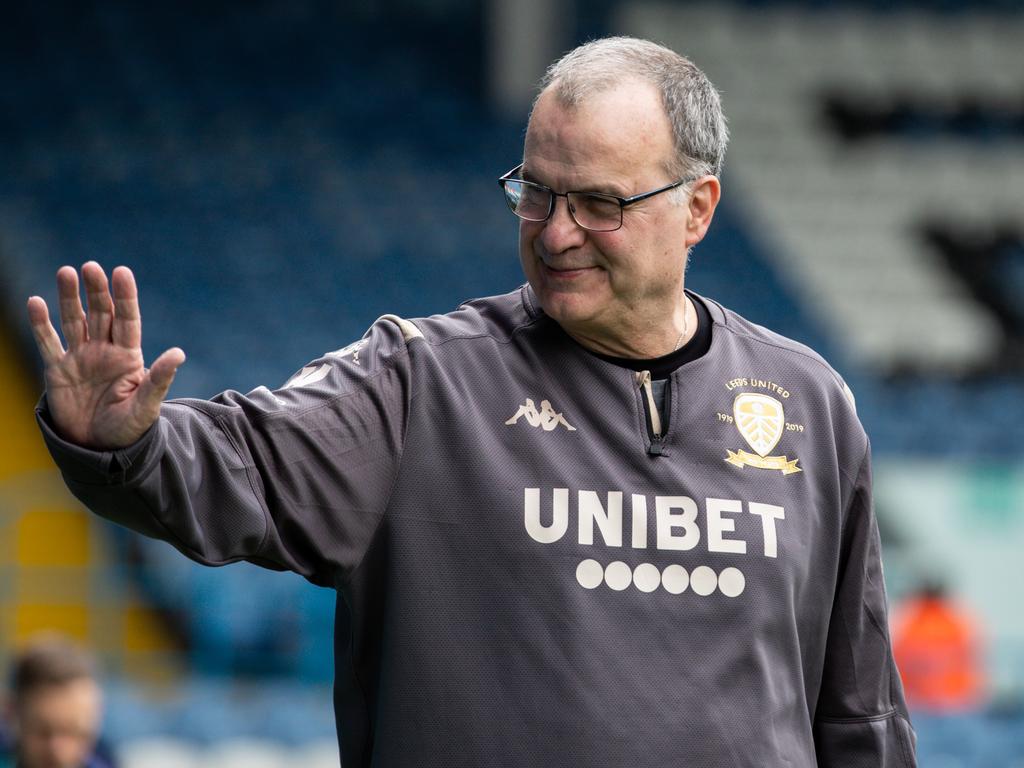
Up the road from Billy’s Barnsley in Hyde Park, Leeds, there is a Marcelo Bielsa mural the size of an end terrace. “A man with new ideas is a madman,” reads the attendant quote. “Until his ideas triumph.” You won’t find a mural on so much as a Beeston outhouse for Dave Hockaday. Or Darko Milanic. Or Paul Heckingbottom. To understand the significance of Bielsa, now reduced to the prosaic nonsense of four bad matches and nanosecond attention spans, you first need to look at Leeds United before he arrived.
That was 2018 and the team were losing to Newport County, losing their best player to a six-match spitting ban, designing silly salute badges and seeing nothing wrong with touring the genocide hotspot of Myanmar. On the pitch they had won four of their past 23 matches. This was better than the previous regime when Massimo Cellino had done the seemingly impossible by failing the owners and directors’ test. I once sat down with him in his office, a half-empty bottle of whiskey behind him, as he said: “You need big balls. Let me tell you something. We had bigger balls before and now we have small balls. We need to blow up our balls again.” Leeds had won three in 22 games at the time. Fans took a coffin to one match.
Mind you, even that was better than what had happened before, when the former managing director David Haigh claimed that he had been the victim of human trafficking, or the time, a decade earlier, when fans woke up one Sunday to read headlines about a plan to cut costs by paying hit men to break Gary Kelly’s legs.

That’s the context. Bielsa instilled an honesty, morality, romance and sometime brilliance into a club that was dirty when it was good and mostly covered in muck and crap like Billy Casper thereafter.
Leeds fans could see the change instantly. Bielsa’s team won their first four games in the Championship. Those playing against pre-season favourites Stoke City in August 2018 included Luke Ayling, Liam Cooper, Jack Harrison, Mateusz Klich and Stuart Dallas. Patrick Bamford and Tyler Roberts were on the bench, all still first-teamers.
He made everyone’s touch better, which is quite something, but it went way beyond that with Leeds, both for the club and the city. It was more his decency. Bear in mind this was the club where Brian Clough pitched up and said: “The first thing you can do for me is chuck all your medals and all your caps and all your pots and all your pans into the biggest f**king dustbin you can find because you’ve never won any of them fairly — you’ve done it all by bloody cheating.”
That was not true, of course, but you get the drift. Bielsa made the players pick up litter. He installed a log burner at the training round for them to take turns maintaining. He went supermarket shopping in his training kit. He walked the 45 minutes from the training ground to his humble Wetherby flat, pulling up his hood and shunning lifts even when it rained. When he did take the car, he stopped to help a cyclist with a puncture. He drank in Costa and gave out lollipops. He never refused a photograph. “They are not asking for a photo of me,” he said. “We live in an individualistic society but this is something which unites people.” Side before selfie, as the other Billy nearly said.
His brother and sister were left-wing politicians who became Argentina’s foreign minister and the deputy governor of Santa Fe province respectively. He was a man of his own people. Then came Spygate, and the first sign that the ever-enraged of English football would never understand him.
For those who have forgotten, Leeds sent an intern to Derby County’s training ground in January 2019. Supposedly, he had bolt-croppers. Esteemed pundits tutted, the message was: “We just don’t do things like that here.” No, our accepted method of cheating is to have players who dive, feign injury, berate referees and are blue-badge abusers.
Spygate was wrong, obviously, but the anger was funny. A press conference was called and people thought Bielsa was going to quit. Instead, he gave a 66-minute PowerPoint presentation to detail not only his own methodology but his own madness.

There is a Little Englander undercurrent sometimes present in the damning of Bielsa and plenty of homegrown coaches griped afterwards that they did the same level of research. As if they did 230 hours on each of their 23 league opponents. “I would like to explain how the brain of a head coach works, or at least those who work like me,” Bielsa said. “Apart from the players in a club you have 20 staff members and these 20 people create a volume of information — absolutely not necessary. It doesn’t define the path of competition, so why do we do it? Because we feel guilty if we don’t work enough; because it allows us not to have too much anxiety.”
He was telling us he did all this merely to satisfy his paranoia, but that got lost because of football’s need to have a row. Bielsa paid the £200,000 fine out of his own pocket.
Not long after came one of the more bizarre things you will ever see in football. Leeds went 1-0 up in a league game while an Aston Villa player lay injured. Villa protested. Leeds felt Jonathan Kodjia was exaggerating because, well, these things happen in football. Bielsa entered this fray and ordered his team to let Villa score. Pontus Jansson, the centre half, was not convinced and tried to kick an opponent anyway, but the rest stood aside. “We did not gift them a goal,” Bielsa said. “We returned it.”
This was his distilled essence, the man who does not moan about VAR or penalties. Bamford dived in that Villa game, but Leeds players rarely do these days because that would go against Bielsa’s values. “The fact that we are not taking care of our planet, our children will pay the consequences of our acts,” he said. “And with football it will be the same.” Without Bielsa-ball, however exposed it can leave a defence, the football climate has now changed for the worse. Jansson was sold.

Anyway, after finishing 13th in 2018, Leeds blew the play-offs in Bielsa’s first year. They went up the following season. As champions — the only thing they had won in 28 years other than the meat raffle in The Peacock. In the Premier League people continued to mock the tactics, but more enlightened observers such as Gary Neville got the sheer bloody bravery of it. They could have put ten men behind the ball and hoped to grind out a draw against the top teams because that’s the accepted way of doing things. But they didn’t. And they lost 4-3 at Anfield in their first top-flight game for 16 years. They beat Manchester City away with ten men, scored three or more goals on 10 occasions, won seven and lost one of their last 10 matches, finished ninth, didn’t burn out. It was their best season since 2002.
Bielsa had his weaknesses. The small squad always looked a huge risk should injuries hit. They did, and it was. Bamford, who scored almost a third of Leeds’ goals last season, has played only six league games. Kalvin Phillips, England’s player of the year and defensive buffer, has not featured for nearly three months. The inability to defend corners continues to cost. But to damn a system as a shambles when that system had tested the imagination of modern football and reaped stupendous results, given the personnel, is too easy.
Leeds have been operating with a mortally depleted squad of elevated Championship players forced, by and large, to play out of position. They have made three big signings since promotion: Raphinha (£17 million), Rodrigo (£26 million) and Dan James (£22 million). Raphinha has worked, but Rodrigo is not as good as Pablo Hernández, and James is much of muchness with Hélder Costa. Their best defender, Ben White, left. Leeds have had to spend merely to stay level with what they were. Blame the board or Bielsa for that, but he was never a “buy, buy, buy” merchant. He was about making players better, as we would have seen with Joe Gelhardt and Lewis Bate next season.
Anyway, he’s gone. Andrea Radrizzani has shot Bambi’s mum, or the Argentine equivalent. I doubt Leeds will ever have as much fun, even if they stay up and one day manage to finish eighth. Against the lesser teams to come I still think Bielsa could have saved Leeds. We will never know, but he challenged the most fundamental principle of professional sport — that it’s all about results. We should all thank him for that.
His legacy is the memories, the murals, the players, the bucket, the quads, songs and season-ticket sales which used his face as their marketing shtick. That old Harry Enfield skit: “Don’t talk to me about sophistication, love — I’ve been to Leeds” no longer worked. “We are widows of Bielsa,” said Felipe Cussen, the Santiago professer-poet, when mourning his departure as Chile manager.
Bamford, one of the players alchemised by Bielsa, perhaps knew what was coming. “Grass isn’t always greener on the other side,” declares his Twitter bio. “It’s greener where you water it.” Shame the board didn’t read that. The bird is back in Billy Casper’s kitchen bin, the flight of fancy is done. It’s joyless again.
– The Times

SuperCoach EPL: How to replace missing AFCON stars

City, Villa keep heat on Arsenal as Spurs fall to Ange’s old side

Slot laughs off farewell game whispers for Salah after tirade

‘No right’: Prickly Slot confirms Reds retaliation after Salah rant

Extraordinary tirade could end Salah’s legendary Liverpool run
