
Five-footed horse Norman Pentaquad sired a Melbourne Cup winner then built Kerry Packer a polo empire
He was born deformed but escaped death. Was tiny but sired a Melbourne Cup winner. Then Norman Pentaquad met Kerry Packer and launched an empire, writes ANDREW RULE.


‘Norman Pentaquad’ sounds more like a Dickens character than a horse.
The great storyteller himself could hardly have spun a more gripping tale of great expectations, broken dreams and redemption than the one that begins when a deformed colt is foaled in Kentucky bluegrass country in 1983.
If horses could talk, Hollywood agents would have worn a trail to Norman’s stable door to hear his story. It starts at Gainesway Farm near Lexington, in the heart of the rolling lime-rich pastures that have produced thousands of racehorses since before the Civil War. In Australia almost 40 years later, his story is still unspooling. No one would have bet on that happening when he was born.
Horses are to Kentucky what poker machines are to Las Vegas, but more risky. When the blueblood mare Lady Rebecca is getting ready to foal to the international stallion Riverman in 1983, the potential value of the bundle of legs is anything that a bunch of competitive multi-millionaires might bid against each other at the high-roller room otherwise known as the Keeneland summer yearling sale.
Breeding thoroughbreds is every bit as dicey as buying or betting on them. When Lady Rebecca lies down on the straw bedding to deliver, it could be the beginning of a fabulous success story. When she stands up an hour or two later to suckle her wobbly chestnut colt, the breeder’s dreams are ashes.
If breeding horses is like drawing cards from a deck, Lady Rebecca’s owner has drawn the Joker. The foal is not only tiny, he’s a freak: he has a fifth foot, a dwarf hoof growing from the pastern just below the bottom joint of one front leg.
This, presumably, led to his unusual name. In a business where bone structure is as prized as it is on the catwalk, such a deformity would usually be a death sentence.
It is a genuinely rare condition, although not as rare as having two extra feet, which is also known. In scientific Latin, the foal is a ‘polydactyl’. People can breed horses all their lives and never see one. One reason for that, of course, is that foals with serious faults, even foals that are the weaker one of a pair of twins, are almost always put down.

The little chestnut colt is lucky he is so royally bred, being descended from a fabled mare, Pocahontas. In a situation where many stud masters would euthanise him, he survives because someone thinks blood counts more than size or shape. So, instead of a bullet, he gets a billet. And an operation to remove the spare hoof.
What the vet does not remove is Norman’s testicles, which is another lucky break. As a racehorse, he is placed only twice in nine starts for $US495 stakemoney. Gelded, he would probably end up as pet meat or a pet hack, maybe a polo pony if he’s lucky. But as a stallion with blue blood, there’s the chance someone, somewhere, will give the sawn-off colt a shot in the breeding barn.
Somebody with a sense of humour names him Norman Pentaquad. Or maybe it’s a sense of history. Alexander the Great’s warhorse, Bucephalus, and Julius Caesar’s favourite horse both had extra toes, according to legend. None of which helps a modern racehorse.
Norman’s pedigree attaches some value to him, especially for potential buyers in New Zealand who see how crazily expensive thoroughbreds have become in North America.
In the 1980s, Kentucky horse breeding goes through a boom never seen before.
Middle Eastern oil sheiks, notably the Maktoums of Dubai, known in Kentucky as the “Doobie Brothers”, start a lifetime bidding war against a syndicate of crafty Irish horse traders working with the English multi-millionaire Robert Sangster.
Four months after deformed Norman is born, another Kentucky breeder hits the jackpot: the Maktoums pay a world record of $US10.2 million for a Northern Dancer yearling at the Keeneland sales just down the road from Gainesway Farm. It is the first time an eight-figure sum is bid for a horse anywhere, and the electronic bid board above the auction ring cannot fit the extra digit.

That elegant colt, sent to the sheikh’s English racing stables to be groomed for glory, is named Snaafi Dancer — a name that becomes a joke. Snaafi is snafu. The colt is so useless on the track that his embarrassed owners never put him in a race. Still, 10 million dollars says he is so aristocratically bred, and such a flawless physical specimen, that they can put him to stud to salvage some of his price tag.
Wrong again. The great Northern Dancer’s dud son is a dud in every way: he is so infertile he gets only four foals, none of them any better than he is himself. Snaafi Dancer looks like the real thing but he is only a replica of a racehorse, as useless as a statue carved from ice. He will end his days hidden away in Florida, his fate a footnote to the folly of paying the price of a private jet for an animal.
Norman Pentaquad, meanwhile, is also exiled far from his old Kentucky home. This happens because a New Zealand stock agent turned studmaster, John Corcoran, contacts a friend in Kentucky looking to buy a stallion as well bred as his previous successful import, War Hawk II.
The friend sends Corcoran Norman Pentaquad’s pedigree page. It is so tempting that the canny Corcoran is tempted to take the punt. The midget born with the extra digit can thank his mother’s family connections for getting him sent safely to the country cousins across the Pacific.
Norman’s mum Lady Rebecca is by Sir Ivor (from famous broodmare Pocahontas) and a half sister to the champion sire Tom Rolfe, and the dam of Alzao, who has sired more than 100 stakes winners. It’s the sort of family tree that gets Norman a ticket to the other side of the world.

It is the era long before the internet, when even international telephone calls are expensive and difficult. Corcoran forgives Norman’s lack of racetrack performance because he knows that if the horse had been a class galloper, his aristocratic pedigree would never be squandered on New Zealand.
Corcoran parts with around $NZ20,000 to buy Norman sight unseen in 1989. It’s not a large amount of money, but when Corcoran lays eyes on his invested he realises he’s hardly purchased a large animal. At 15.1 hands (153cm long), Norman may be the smallest imported thoroughbred sire in memory. Slurs about breeding ponies about breeding ponies are ignored and the new stallion is found a home at Corcoran’s Grangewilliam Stud, a former cattle farm near South Taranaki bought with the proceeds of a huge win on a “pick six” at a country race meeting years before. But not all punts work out that way.
Soon enough, for a modest fee of $NZ2500 or so, the little horse tosses up something special. Norman’s first crop in 1990 produces a wiry chestnut that gallops like a machine, belying appearances.
Fat lambs and All Blacks aside, race horses rank among New Zealand’s greatest exports.
Norman’s lookalike son shows enough promise in his first three starts that an agent, John Devlin, gets a videotape of the raw youngster winning a race by an extravagant margin. It is one of several videos of New Zealand horses for sale he sends to his Melbourne friend, Danny Power, who is involved with the then emerging trainers, the Freedman brothers.

Power, racing writer by trade, bloodstock fancier by instinct, watches the video with a racehorse syndicator, Terry Henderson. Power says “I like this horse” and Henderson promises to buy a half share if Power can find owners for the other half. They cobble together a syndicate, including the horse’s New Zealand owner, a tough old character who retains 10 per cent because his wife wisely insists on it.
The horse is flown to Queensland, where the youngest of the four Freedmans, Michael, is campaigning a couple of their best horses in the winter of 1994. When Michael Freedman sees the new horse unloaded he shakes his head and grunts, “What have they sent us — a bloody polo pony?”
They gallop him later that week and the Freedmans never criticise him again. The “polo pony” is Doriemus, who goes on to win the Caulfield Cup-Melbourne Cup double in 1995, and to lose a second Melbourne Cup in a photo finish with the champion Might And Power. He wins and runs places in some of the best races of the era, earning $3.58 million before retiring after the 1998 Melbourne Cup.

Back in his adopted home on Grangewilliam Stud near Taranaki, Norman Pentaquad is a local hero for getting a Melbourne Cup winner, but that isn’t enough. He never attracts enough high quality mares to sire enough high quality racehorses to complete the virtuous circle of attracting more good mares. It is the same dilemma for a lot of stallions who fade from view after a few years. Each season, Norman loses ground in the breeding shed, even while Doriemus is still making history in Australia. Doriemus is a talking point but that’s not a selling point in the most unsentimental business outside the boxing ring.
Within two years of Doriemus’ Caulfield-Melbourne Cup double though, Norman is virtually unsellable. Corcoran is resigned to his little stallion not fitting the “commercial” bill buyers desired, but he can’t bring himself to have the horse put down. The Kaimanawa ranges around Lake Taupo offer an alternative, just turn Norman loose, take him “up the Desert Road” and let him go, is the way he puts it later. The Kaimanawa wild horses are New Zealand’s equivalent of brumbies, but are managed better.
Before Corcoran gets around to letting Norman go in the wilderness, chance plays a card. While racehorse breeders have shunned Norman, polo players have started to badger Corcoran for the little stallion’s cast-off progeny. They are small and tough and wiry and take to polo the way kelpie pups work sheep. Word spreads and before Corcoran gets around to turning the horse loose, a mystery buyer turns up, looking for polo prospects among Norman’s unwanted offspring. Anything considered too weedy to go to the sale ring is fine by the polo man.
Corcoran has a better idea. “Buy him and breed ’em yourself”, Corcoran tells the visitor, pointing at Norman. He wants to get the stallion off the place but he’s not going to give him away, exactly. Always the Kiwi horse dealer, he instantly shelves the plan to turn him out in the hills to fend for himself with the wild horses. Instead, he thinks of a price (“ten grand”) and then automatically doubles it as a starting point for negotiations.
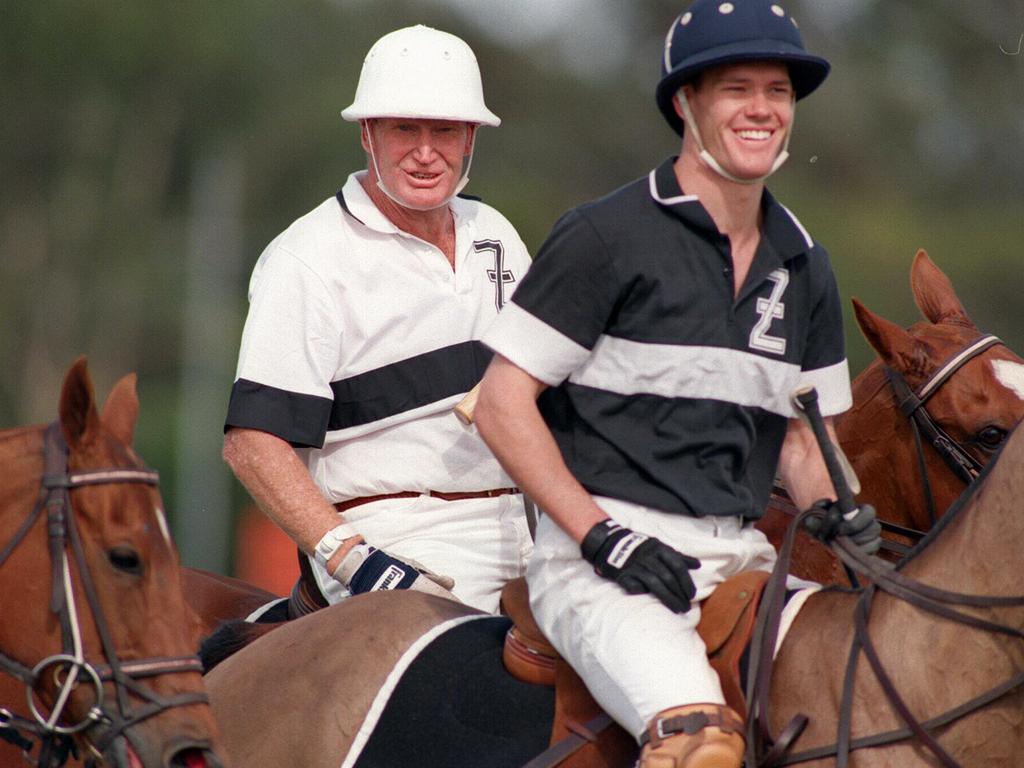
The buyer doesn’t blink, and pulls out a cheque book. No wonder, as it turns out, that a few thousand dollars more or less doesn’t bother him. Norman is headed for Kerry Packer’s showpiece property in the Hunter Valley, Ellerston, one of the polo studs Australia’s richest man then owns around the world. His price is less than a small bet for Packer, reputed to have once spent a million dollars on entertaining jockeys during the intriguing Melbourne spring carnival in which his horse Mahogany won the Victoria Derby with devastating ease.
As for Norman Pentaquad, an anonymous ending is discarded for status as a polo legend. The ‘Zabeel of polo’ is how Ellerston stud manager Jim Gilmore comes to regard the old stallion, jealously guarding his legacy in the process. Few outsiders are permitted to bring their mares but Norman has his own harem and the stud uses embryo transfer to send his prized genes the world over.

The game of kings is ultimately played by some of the world’s best on the prized progeny of Norman – the cast-off who dodged a bullet and being left to run with wild beasts through the ranges.
He is eventually retired to the paddock at the age of 26, serving mares but only delivering seven in foal. There is still a succession plan though: the best of his many sons take over the breeding shed from Norman the conqueror.
As far as anyone knows, none of his foals are born with an extra foot.
**Norman Pentaquad died at the great age of 31 and is buried at Ellerston with a headstone. Almost a hundred world-class polo ponies offered at Ellerston’s reduction sale in 2015 were descended from him. In 2020, Ellerston Polo announced that its scientists have cloned Norman Pentaquad in America — and that the clone will return to the Australian property to breed. Norman lives again.

Doudle mulls Magic Millions auditions for ‘Swiftie’

Price is right for a Guest House on the Gold Coast in January

Terang Tuesday tips: $9 value bet

Beaumont Newcastle Tuesday tips: $3.20 best bet

Beaumont Tuesday preview: Martino blueblood can ‘Star’ at stable debut
