
The Netball GOAT, Part II: Iconic goal keeper Liz Ellis tops shooting legends for a podium place
Twenty-five players earned votes in a CODE Sports poll seeking to crown netball’s greatest player of all time. In Part II of a special series, LINDA PEARCE reveals every name up to No.3.

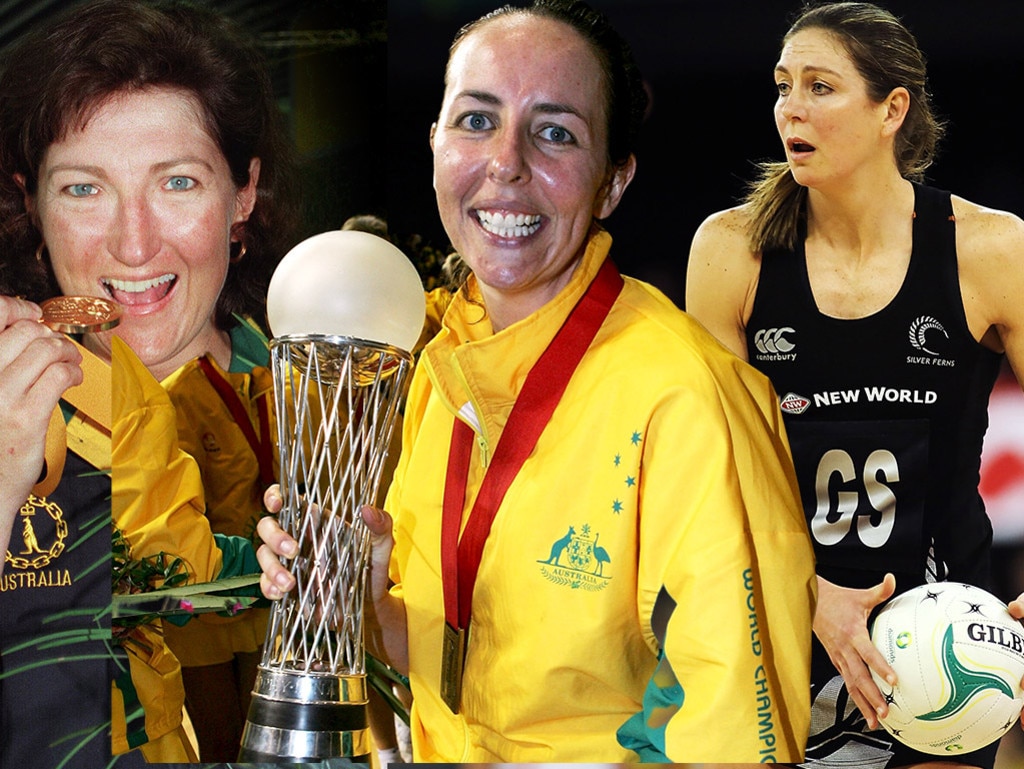
The one-carat, rare white sparkler presented annually since 2008 to the Diamonds’ best-performed player carries the name of the netballer described on Netball Australia’s website as the nation’s “most capped and celebrated”.
Yet although the Liz Ellis Diamond is the sport’s pre-eminent individual award, the 122-Test former defensive great is at the head of a peloton bunched behind the leading duo voted for by over 60 former and current players, coaches and officials in CODE Sports’ informal poll of the greatest of all time.
While a subjective exercise admittedly more random than scientific – for not just the obvious reasons, but the fact that just over two-thirds of respondents managed to narrow the field to one, while others named between two and six – there were 25 names in a conversation that could easily have stretched to dozens more.
In the end, Ellis claimed the bronze medal position ahead of her great rival Irene van Dyk, who was tied with another legendary shooter, Australian Vicki Wilson. Ellis received four votes to three, plus an extra half, with other part-points going to each of the trio from the less decisive of those surveyed.
Yet Kim Green was one retired star who had no hesitation in naming Ellis — her captain early in a 212-game national league career with the Swifts and Giants — as the best she has seen, with physical qualities such as elevation, reach and anticipation among the elements that made her so.
“The way she was able to play goal keeper allowed me to do what I could do best, which was to go a little bit wild in attack and throw whatever I wanted to throw, because I knew that if I threw a bad one, she’d be able to get it back!’’ says Green, who also played 74 Tests for two World Cups and a Commonwealth Games gold.
“She had incredible tenacity, that never-give-up attitude, and her rejections of the shot … the shooters must have been shaking in their boots. I’m sure that’s what shooters feel like against Shamera (Sterling, a current standout at ‘keeper) but without the 100 per cent pressure that Lizzy would do in the lead-up.’’
READ MORE
NETBALL GOAT PART I: LEGENDS NAME THEIR BEST-EVER PLAYERS
NETBALL GOAT PART III: McMAHON REIGNS SUPREME OVER FERNS ICON
INSIDE THE DYSFUNCTIONAL BIRTH OF COLLINGWOOD NETBALL
CHATFIELD: DIAMOND CLAIMS KEY SPOT, ENGLAND 'WEAPON' BOUND FOR SSN
MEDHURST: THE SILENT PAIN I KEPT HIDDEN

Then there was the leadership and standard-setting. Forthright, shall we say; perhaps bordering on “brutal” at times, according to Green.
“Liz was the first person to say that she didn’t have a good game, but she also just lifted everyone and made sure they were up to her level. If they weren’t, you’d know about it.’’
An example came early in Green’s career, after a substandard performance for the Swifts against the Melbourne Phoenix. “She gave me a good old hiding about it verbally and I remember walking out of that change-room thinking, ‘Don’t cry, don’t cry, don’t cry’.
“I got home and one of my teammates called me and said, ‘Are you OK? And I was like, ‘I’m fine. That’s what I needed’. I remember thinking, ‘If someone is that passionate about something, I clearly have dropped the ball’.
“So I needed to work on that, and credit to Liz. She wasn’t afraid to say what was needed and she knew that I could take it as well. She was just such a strong female presence. I’d never seen anything like it.’’
Still the sport’s best-known Australian identity, 16 years after retiring with five world and Commonwealth titles from seven pinnacle tournaments, the host, commentator, panellist and reality TV star is also credited with helping to improve pay and conditions for players, and grow interest in the game.
Her long-time coach Julie Fitzgerald, former teammate Susan Pettitt and current Swift Maddy Proud also give Ellis the nod, while Keeley Devery groups her alongside Annie Sargeant — perhaps the first true netball celebrity, plus a brilliant shooter and captain — as the best-ever.
Fitzgerald believes that Ellis, always driven to improve and succeed, ticked every on-and-off-court box. “Even when she was a ratty 17-year-old, which is when I think I first coached her, she just always had the desire to be the best that she could be.
“Her whole attitude was, ‘Why can’t it be me? Why can’t I be the world’s best?’’’

*****
Ellis’ own pick comes from a familiarity that bred the utmost respect: van Dyk the South African turned New Zealand great, who earned a record 217 caps combined over 20 years, while scoring 5,917 goals at 90 per cent accuracy.
“There’s players who were unbelievably good for a short period of time and then came back to the pack a little bit, and then there were people who were amazing for a long time,’’ says Ellis, placing van Dyk at the top of category two.
“Irene changed her game up over the years, so she was a completely different player when she finished playing than when she started. She was never the same one season to another. She was always the best or close to the best player in international netball and she was continually reinventing herself and working on her game.
“You knew when you played against her that there was always something she had up her sleeve, and even towards the end of her career when she wasn’t shooting 40 goals a game, she was a really good foil for people like Maria Tutaia (now Folau). So I just think she’s probably the greatest netball player that I saw.’’
Ellis acknowledges that van Dyk’s excellence made her own game better, by necessity; a 10cm height discrepancy required the use of other tools.
Stressing that she is judging only from a post-1991 perspective, there’s no question that a larger cohort of Kiwi voters would have pushed the towering shooter higher up the list.
Van Dyk got Laura Langman’s vote, though, which speaks volumes, as well as that of former Diamonds defender and long-time elite coach Jane Searle.

Vicki Wilson was another recurring name — as not just Sharelle McMahon’s pick but also Kathryn Harby-Williams’ and Carissa Tombs’ (nee Dalwood). The standout Australian spearhead of the 1990s, Wilson captained the Diamonds to inaugural Commonwealth Games gold, plus the last of her three world titles in 1999.
The numbers fail to do full justice to her presence, though; the strength, strut, fierceness, self-assurance, reliability and consistency, whatever the pressure or occasion.
No-nonsense Wilson was slightly scary at times, not least for the opposition, with a young McMahon grateful for enough immovable screens in the goal circle to know that here was not an obstacle she fancied running into. She was always happy to have Wilson on her side.
“Vicki taught me an enormous amount about being an Australian netballer and what it took, and the dedication, and I soaked that up and I loved it. She was so giving, so it’s a bit of a personal one for me,’’ says McMahon of her choice of Wilson as No.1, just shading van Dyk.
“I remember watching her in the 1991 world championship win, in very tight circumstances. It was the first time I ever really even clocked that there was an Australian netball team and as a young country kid, it was Vicki (who resonated) and I was like, ‘I wanna be like her’.’’
Harby-Williams, a defender who received two votes herself, said: “Netball’s a shooters’ game, for starters, and Vicki was a shooter from any range. She demanded the ball and in her heyday when you got it in the circle, you could put your glasses down.
“Just so strong, uncompromising, great leader. Everything you want in a power forward that helps you win big games.’’

*****
A breath behind that trio were Silver Ferns’ shooter Folau (nee Tutaia), Harby-Williams and defender Michelle den Dekker (or Fielke, for much of her career).
“For me, Michelle was the ultimate athlete who probably changed the way the game was played a little bit, in terms of that athleticism and how she used it,’’ says current Australian selector and former midcourter Michelle Wilkins.
“Particularly her ability to shut down opponents but then go hunting for the ball, which I think is a method of play now that everyone’s really working defensively towards.’’
Also known also for her professionalism and clean bodywork (or, in the words of Sue Hawkins, “all skill, no biffing’’ style), den Dekker led Australia to the 1991 and 1995 world titles, and captained (with an extraordinary 65-6 win-loss record) 71 of her 84 Tests.
Described as being “the full package” by her long-time former teammate Jenny Borlase, den Dekker was also in Sargeant’s equal top-two, and Nicole Richardson’s fab four.
“She was ahead of her time as far as her athleticism and the benchmarks that she set from a physical attributes point of view,’’ said Borlase, whose daughter Isobel is an emerging WBNL star, and son James plays for the Adelaide Crows.
“Physically, Michelle would have been able to excel at any sport. We were fortunate that we had her in netball but she just set amazingly high standards across the physical capabilities required for the sport.
“She was big in critical moments. She was a big-game player, and in that goal defence position she read the play well but she then just matched that with her physical capabilities, so I think she was able to do things that other players, prior to her time, probably didn’t do.’’

Sargeant also valued den Dekker’s versatility, instincts, strategic nous and play-reading ability. “She played the game in an inspiring fashion that could lift the game, create the moment, but apply relentless pressure along the way. And very pretty to watch in terms of her movements and her skill set.’’
Prolific long-bomber Folau — favoured by Australia’s Hawkins, her well-travelled former Auckland coach, as well as 1960s Diamond Jeanette Cato (nee McIver) — is another whose legend is far greater across the ditch but still much respected on these shores.
Along with sustained brilliance in 185 games at domestic level, her deadly shooting for the Ferns made Folau a key contributor to double Commonwealth Games gold in 2006 and 2010, plus the drought-breaking 2019 World Cup triumph in Liverpool, in her emotional 150th Test; her last.
“Cool under pressure, won that world championship for New Zealand, unfortunately has just now disappeared off the face of the earth and never got the farewell that she deserved, because that was all when her husband (Israel) was saying those horrible things in the media,’’ Hawkins laments.
“She had this calmness and aloofness about her. People were trying to upset her all the time on the court but … the pressure would just roll off her. A hard-nosed trainer, never cut corners, but always had a smile on her dial and looked like she just enjoyed her games.’’

Then there was Harby-Williams, long before her prominent post-retirement role as CEO of the players’ union, who garnered a slice of the SA vote from her long-time coach Marg Angove and former Diamonds teammate Peta Scholz; the latter explaining a simple “must be an Aussie and must be a defender” selection philosophy.
Meanwhile, Angove’s rationale was that she saw from a coaching perspective Harby-Williams’ ability to change the course of games through a natural play-reading that could not be taught.
Nor was a battle of wills easily won. “She wasn’t the easiest athlete to coach at times, she wasn’t that keen on training hard and she was a hard master, too. I remember one day when the Thunderbirds weren’t at their top, I had a defender behind Kathryn (at GK) and she says, ‘Get her off. It’s fresh air behind me, Marg’.
“And it certainly was fresh air behind her, too, but I looked at the bench and I thought, ‘My God, there’s more fresh air there!’. But she led by the way she played and she’s pretty much a carefree person, too. She had so much natural ability, the strong desire to be the best that she could be and a strong desire to win.’’

*****
So to the one-voters, in no particular order, with their nominators in brackets.
Geva Mentor (Sharon Finnan-White), Sue Kenny (Megan Anderson), Sandra Edge (den Dekker), Carissa Tombs (Nicole Cusack), Karan Smith (Joyce Brown), Tobiana Louw (Elsma Merillo), Jean Pierre (Wilma Shakespear), Marg Caldow (Caitlin Bassett), Julie Corletto (Kiera Austin), Shamera Sterling (Romelda Aiken-George).
Others to feature in the shallow end of CODE’s deep dive were Simone McKinnis, Jo Harten, Wai Taumaunu, Lesley Nicol, Gretel Bueta and Jhaniele Fowler.
Corletto, who famously and so courageously completed the 2015 World Cup final with a broken foot, was mentioned regularly and admiringly, not least from two of her former coaches, Lisa Alexander and Rob Wright, as well as current star Austin.
Sargeant received half-votes from Wilson, Noeleen Dix and Devery, with the latter noting a grace that belied the renowned ex-goaler’s toughness and competitiveness.
“Annie was extraordinary, just beautiful to watch, and got in the circle and shot it from anywhere, handled pressure amazingly and just stood up,’’ says Devery, a teammate and opponent of the long-time national selector.
“You know those sort of players that you go, ‘Ball’s in their hands, we’re right’. She was one of those players. Then I also think of what she’s done off the court, for the game, paved the way for so much.’’

Wilson also admired Sargeant’s willingness to go to the post. “Fearless would be the word I would use. There was no stuffing around in the goal circle; wherever she got it, she put it up and it went in, and she had great flow to her game. In attack, she just presented this really clean, clear option, and defensively she contributed as well, but Annie was also a good director of play.’’
Sargeant, who made her name as a commentator and public speaker after hanging up the GA bib in 1988, admitted that she hesitated to return this reporter’s call given the “mission impossible” of the request.
More Coverage


“You’re talking about different playing surfaces, different shoes, different opponents, different sports science to create these players,’’ says Sargeant, querying the validity of juxtaposing contrasting eras and the wisdom of trying.
“Most people only think of recent generations, number one, and the original ones were playing on asphalt in wind and rain and in boots, and how they could sustain what they did and the skill level they did is monumental. It’s an unfair comparison from that point of view.’’
Still, we got there eventually — den Dekker tying in Sargeant’s view with another athletic dynamo who came along later in the 1990s and, in the words of current Diamonds coach Stacey Marinkovich, “revolutionised the game’’.

‘Not in the gutter’: Netball star fires back at haters

Opinion: Why Tassie’s had enough of being the support act

The self-confessed ‘netball nerd’ stepping into the Mavs’ hot seat

Diamonds lock in powerhouse series ahead of Comm Games

The making of Gerard Murphy – and why he’s ready for Mavs challenge
