
Beyond the Cedric Dubler moment, Ash Moloney could become ‘greatest athlete of the century’
Australia was inspired as Cedric Dubler urged Ash Moloney to bronze in the Olympic decathlon. But the act of mateship overshadowed the astonishing gravity of what happened, and of what’s to come.

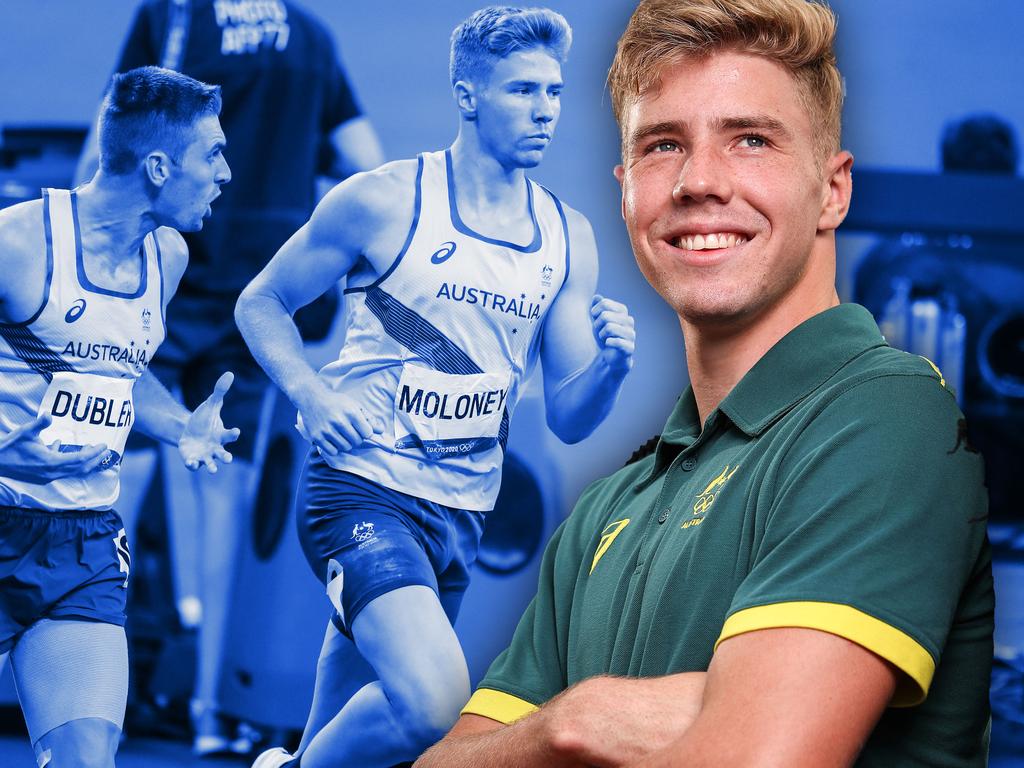
Amid the clamour to hail Olympian Cedric Dubler as the epitome of selfless Aussie mateship for being, as he puts it, “the guy who yelled at that other guy to help him get the bronze medal”, the decathlon’s 21st finisher has been rewarded with national admiration, at least one free haircut and the chance to launch a new sideline gig as a motivational speaker.
And as for Ash Moloney? The medal-winning, history-making young Queenslander whose achievement seems almost to have been overshadowed by the feel-good power of the buddy narrative?
At just 21, in an event so demanding it is typically dominated by the more mature bodies of seasoned competitors, Moloney is an emerging star of such soaring potential that his coach predicts he could become the athlete of the century and set a world record that will not be broken for 50 years.
Big statements, yes, but veteran multi-events guru Eric Brown knows an immense talent when he sees one, and since 2015 has witnessed the marriage of those genetic gifts with an outstanding work ethic and temperament.
All of which, despite suffering a serious pre-Covid Lisfranc fracture in his foot, and while dealing with ongoing patellar tendinitis that has forced Moloney to jump off the wrong leg in field events and compromised his throws, added up to a 8649-point national record and a place on the podium in Tokyo.
“He doesn’t like to be labelled that, but this young man certainly could become the greatest athlete of the century,” Brown says. “You think about the world records that have gone up in the decath, like 10 or 20 points at a time, and imagine if someone broke that by 300 or 400 or 500 points.’’ Brown says.
The veteran coach duly points to a 1990s study that revealed a typical 900-1200 point improvement in elite decathletes from 21-years-old to full maturity, with Moloney now just 477 behind 29-year-old Canadian Kevin Mayer’s current world record mark.
“If his knees come good, my goodness me, watch out. The fact that he’s doing this well with that issue for a long period of time is just staggering. The kid’s just freakish. He’ll break the world record by so far in a year or so it will probably stand for 50 years. That’s how good he is.’’
Brown’s greatest challenge may be slowing Moloney down. If anything, his natural tendency is to over-train. He loves the routine and gets irritable without it. A disciple of the ‘go hard or go home’ philosophy has the attitude that if you’re not at risk of injury, then you’re not pushing your body hard enough. And for as much pain as he was in during the Tokyo high jump, in particular, there was never a chance he would not finish.
“Look, I would compete if I had someone stabbing me in the heart,” he declares. Convincingly.

Supermen without capes
When Caitlin Jenner was still Bruce, the American was the acclaimed decathlon champion at the 1976 Montreal Olympics. When Daley Thompson followed, in consecutive Games, the British superstar and four-time world record-breaker was the self-proclaimed greatest athlete in the world, given the taxing nature of 10 events across two days.
Moloney is from a more understated mould. His go-to phrase upon hearing heady predictions is that it gets thrown “in the bin”, mentally. He is happy to be experiencing the difference winning a medal makes, while quoting the line that “performance buys privilege’’, knowing it is a small spend. At least for now.
“You have to be extremely marketable [to make a lot of money] and I don’t think I [am],” he says. “I mean, I’m a white caucasian male who does athletics. I’m not the first guy to do that. But I think if I keep the trend going, I can make a living off it.”
Moloney is still largely funded by “the bank of mum and dad”, even if his old ute was replaced recently by a Nissan Patrol to indulge his love of bush-bashing. His greatest let-the-hair-down splurge was a few weeks of excessive McDonalds, and he proudly volunteers the order as a double-this-and-that which weighs up to a nutritionist’s nightmare. But well-earned, as were a few beers with his mates. Decompression essential. “Now I can tie my hair up and I’m satisfied and ready to do it all again.”
Back home in Jimboomba, south of Brisbane, parents Alison and Neil keep the fridge and the pantry well-stocked for their robust, constantly-hungry lad. A request for the assurance, please, that mum does not still do his washing prompts a chuckled, “Um, no comment”.
It’s one of many reminders of just how young Moloney is; in decathlon terms, remarkably so. So how has he gotten there so soon?
“I’ve given up a lot of things in my life,” he says. “I haven’t studied at uni, I haven’t gone and gotten a job yet, haven’t done all those things. I know I probably should have but I was just so dedicated and I really, really, really wanted it, so I just dropped everything and my parents and my coach and QAS (Queensland Academy of Sport) were just unbelievably supportive and got me to where I was dreaming to go.”

Yet that single-minded focus, in a sport offering minimal financial support/reward below the very pointy end, can also breed anxiety.
“Every night you go to bed and you’re like, ‘Am I doing the right thing?’ And that’s probably why I felt relief as well [in Tokyo], because I was like, ‘Oh, wow, am I actually going to make a career out of this or am I just going to be another person who’s dropped everything in their life and ends up on the street?’
“And that’s my biggest fear. I don’t want to be homeless or anything and that’s the reality for some athletes, that they drop everything, and they could be extremely talented and then they get one injury and they’re done. And that’s really scary to think about.” How often? “I think about it probably every second day. All athletes do, who are at that level. It can end in, literally, a click.”
Still, so rapidly has he risen that the Olympics was the first meet Moloney entered without the reasonable expectation of a top-three finish. In fact, he struggled to feel like he belonged, initially, and was so nervous he almost didn’t want to compete. That changed quickly, however, in the fraternal, supportive decathlon environment that is considered unique in men’s track and field.
“When I got into that room and I got amongst the boys and the decath camaraderie, all that fun stuff, I just felt comfortable. I was, ‘All right, this is just like any other decath – go hard, go home … Then when I got the medal, I was like, ‘How the hell did I get this thing? Did it just happen?’ Even now, I look at it and I’m like, ‘Is this even mine? Did I steal it?’ Maybe I did! I just did so well I stole it.’’
As we speak, someone else might be about to, given Moloney had left his Tokyo treasure “chilling” in the Patrol, away from its normal home on the kitchen table. It’s his family’s medal, he says, and aunties, mates et al should get to take it out of the case and enjoy it, too. “Everyone loves it, so I just kind of leave it out there.”
Injuries permitting, one suspects there will be many more; potentially all the way through to a 2032 home Olympics that is Moloney‘s ideal end game. A stacked 2022 starts with the World Indoors in Serbia in late March before the July world championships and Commonwealth Games scheduled back-to-back.
“I don’t know how I’m going to go to a war in the world champs and come out the other side and try and do Comm Games, but we’ll see how we go. It honestly feels like I have to put the battle paint on and get ready to go.” A good result: “Anything above third. I’ve got a progression to do now. I’ve got to get all the colours.”

The first nine
Decathlon is a supreme sporting test. Physically and mentally, for so much can go wrong. It might be wind and rain adding treachery to the pole vault. Or the risk of fouls in the long jump. Pressure, meet exhilaration, in athletics’ version of living on the edge.
“I would say it’s like driving a car on a cliff face,” Moloney says.
“Long jump, you could foul out in the second event of the day and that’s like your whole decath done, cos you can’t make up 900 points anywhere else. It’s extremely cutthroat. And you could get to javelin and do your elbow in the first throw, and then you’re done. You do nine events and then suddenly you do your elbow and suddenly it’s like, ‘Oh, I just threw 10m, I can’t win this anymore’.”
The first five events are the 100m (second fastest in Tokyo), long jump (third), shot put (15th), high jump (equal first) and 400m (first). Runner/jumper is Moloney’s wheelhouse, mostly. That night, in second place, he returned to the athletes’ village to treat his chronically sore knees but woke up in better morning-after shape than usual. Next came the 100m hurdles (fourth), discus (15th) and pole vault (seventh, after a slip), before he tore his UCL in his elbow during the javelin (17th); mistaking it for the noise of a groaning body and only aware later it would mean spending four weeks in a brace.

What sounds like a form of masochism is something Moloney equates to finishing a marathon. “The feeling after doing the decathlon is an achievement in itself. You’re just so proud of yourself after every one you complete and I still am, every time, even if it’s a bad one.”
In this exceptional performance, each high jump was accompanied by “unbelievable pain. I was trying to hide it, cos you know, I’m a man, I’ve gotta hide it!’” he laughs. Did he succeed? “Um, no.”
The limp might have been a giveaway, as was his strategy of passing on pretty much every second height. ‘‘I don’t know how, but I was jumping in the best form of my life with the most pain ever. Each time I went over the bar I was like, ‘How the hell did I clear that?’ And I think I clipped every single height.” The Gods were smiling. “Oh, they definitely were.”
Back home in Brisbane, Brown was watching this once-in-a-lifetime kid, convinced that there is what he calls “mega-improvement” left in all 10 events. The coach says Moloney can run close to 10-flat in the 100m. There’s an even bigger upside in hurdles. “Off the scale” long jump potential. Headed for a sub-45 400m. Javelin technique will click when he can put some force through his left knee. Etc. Etc.
“People don’t realise he’s been jumping off his wrong leg in high jump and long jump and nudging the world’s best. He’s not even on the correct take-off leg – it’s ridiculous! Nobody does that. It’s insane,” Brown says.
“Potentially, this kid could make the Olympics as an individual athlete in about five events. He is just so strong and so fast and so dynamic and he can run, jump and throw. ”

The finale
Third place. One event to go: the searing test for weary athletes that is the 1500m. Moloney knew he must not let American Garrett Scantling out of his sight, for if he could stay within about five seconds, he could not be overtaken for bronze. The time he knew he needed was one he had run often in training.
“I was feeling pretty rubbish, very nervous, but I knew I had it in me,” Moloney says. “So I knew what I had to do. I knew exactly how to execute. I just needed to execute.”
In a common collaborative tactic among decathletes, his training partner Dubler had been enlisted to stay close and help make sure nothing went wrong; Dubler’s own chances having been scuttled by a hamstring strain two weeks before the Games and confirmed by a no-height in the pole vault.
A zombie-like Moloney recalls feeling so exhausted he resembled a robot, but says that even when Dubler – who had paced him in the first lap as planned – famously urged him on at the bell, he was never concerned. “Nah. I was planning to kick in the last 600 anyway; it just took me a long time to get the wheels going.” It was a comfortable buffer in the end.

Moloney politely declines to comment on how he feels about his teammate receiving so much of the credit. Brown says it was good for the sport that Dubler volunteered to run with Moloney and became part of a moment in history that will long be remembered.
“It has promoted the decathlon like never before and made people realise how good these athletes are,” Brown says. “The press probably unintentionally took the spotlight away from Ash. His performance was the best ever in the history for a 21-year-old decathlete and it’s a shame nobody focused on that. No 21-year-old has ever won an Olympic decathlon medal, let alone get the incredible score he got.
“It was a terrific sporting gesture by Cedric. If you asked me if Ash would have done it on his own, I would answer yes. But if he had made a mistake, Cedric was there to push him to his limit. Fortunately, it all went to plan.”

Epilogue
Dubler left Brown’s squad soon after returning from Tokyo, ending an 11-year relationship on what both insist were good terms. Ahead of the 2024 Paris Games, dual Olympian Dubler says he plans to structure his training slightly differently in what may be a three-year approach to his own finishing line.
The 26-year-old is hoping to earn enough to be a full-time athlete until then, having received what he describes as an “incredible” reaction from the Australian public. “People remember the decathlon and they remember the 1500 and they remember me, so it’s been really special. Not often, I think, do people get remembered for their non-athletic performances.” He believes this moment resonated because it represented something bigger.
So is Cedric at all uncomfortable about all the ‘Doing a Dubler’ fuss made of him? “A little bit. Yeah, I feel bad that I did receive a lot of attention, but I think in general as a pair we received a lot of attention together and I think that helps the sport of decathlon grow in Australia.”
Moloney is now working with a new strength and conditioning coach, David Watts, as Dubler’s decision to go his own way simultaneously gives his friend some clear air.
“It’s been incredible (to train) with Ash for so many years and he’s still got an incredible structure with Eric and I think the only thing that he’s missing now is more experience at those competitions,” Dubler says.
“He knows that to get to the next level he needs his own team and he needs his own space to develop as an athlete, so that’s exactly what he’s building at the moment.
“Ash could be the best of all time, and I don’t say that lightly because there have been some incredible decathletes that have come through, and especially recently. I think everyone knows that Ash could be something really, really special. So if the next few years go well for him, if he can stay injury-free and come up with a really good plan and strategise about how to fix some of his weaknesses in certain events, then he will be unstoppable and he could break the world record.”
And everyone, it seems, can agree on that.

From coma to champion: BMX star’s comeback finds a new track

She miscarried last week – now this brave Olympian is taking on a triathlon

1000+ athletes to benefit from revolutionary $50m retirement fund

False start as Ian Thorpe prepares for wild ride in Sydney to Hobart yacht race

‘Definitely reasonable’: Teen Olympian backs social media ban
