
Kyle Chalmers has elected to undergo immediate shoulder surgery as he prepares for massive 2022
EXCLUSIVE: Kyle Chalmers tells Linda Pearce why he has decided to go under the knife ahead of a massive 2022 swimming season.

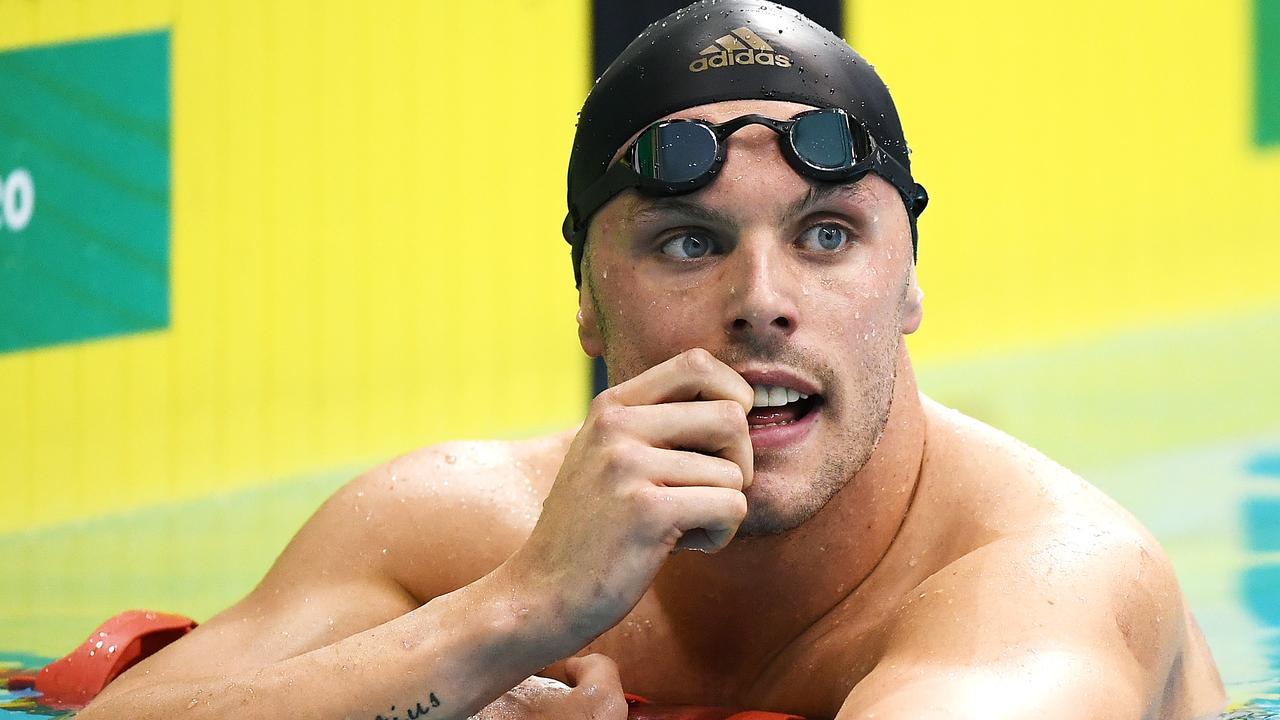
Olympic silver medallist Kyle Chalmers has sacrificed a potential six-figure payday at next week’s World Short Course Championships to return to Australia for another round of shoulder surgery – optimistic that the timing will allow adequate preparation time for the world long course titles and Commonwealth Games in a busy 2022.
In the latest injury setback for the 100-metre freestyle gold medallist from the 2016 Rio Games, Chalmers will meet surgeon Professor Des Bokor in Sydney on Friday, with an arthroscope on his right shoulder scheduled for Monday.
A similar operation on his left shoulder 12 months ago compromised the South Australian’s build-up for Tokyo – where the 23-year-old nevertheless equalled his personal best of 47.08 seconds in the blue ribbon freestyle final but was shaded by just 0.06 of a second by US star Caleb Dressel.
Chalmers – who has also endured three heart operations, most recently in 2019 – added two relay bronze medals in Tokyo to take his overall Olympic medal tally to six.
Currently isolating in Sydney for 72 hours after arriving from Europe late on Tuesday, Chalmers told CODE he had made the difficult decision to withdraw from the FINA World Swimming Championships (25m) starting in Abu Dhabi next Thursday despite the enticing prizemoney lure.
Having set a short course world record in the 100m freestyle world at the World Cup meet in Kazan on October 30, crushing Frenchman Amaury Leveaux’s 13-year-old mark set in the super suit era, another personal best would have earned Chalmers a bonus of US$50,000, on top of US$15,000 for a gold medal and US$10,000 for silver from either of his two planned swims.

“I had to cut the trip short – I got a cortisone (injection) in my shoulder to try and get me through that last competition, but it’s been a bit frustrating,’’ Chalmers said. “My shoulder I had surgery on is pretty good now, whereas this one started to blow out just before the Olympics, so my good shoulder is now my bad shoulder.’’
Chalmers said he was warned when departing in late August for an extended competitive trip to the International Swimming League and World Cup circuit, where he contested 11 meets in 13 weeks, that – following MRI scans and an early cortisone jab – he may not last until December.
“They said ‘come home as soon as it’s no good’, so I was kind of not expecting to get 13 weeks through but managed to get that far into it, and now I’ll just get it cleaned out and sorted and start building again,’’ Chalmers said, admitting he was unsure of the exact nature of the injury, but suspected there were no major tears.
“I think they’ll take the bursar out and I’m sure if they find anything they’ll fix it while they’re in there and do what they need to do and once the scars are healed I’ll be back in the pool … but I don’t know exactly what’s going to happen until probably I’ve had the surgery done really, like last time.’’
With the FINA world championships scheduled for mid-May in Fukuoka, Japan, Chalmers hopes to be back training on January 1. The UK city of Birmingham will host the Commonwealth Games from July 28.

“Obviously next year’s such a massive year and if I did do world short course I wouldn’t have been able to have surgery until at least January the 17th … so it was just going to be too short of a turnaround to get back for world champs.
“So I had to pull the pin on that, which was a really really hard decision for me to take. I’ve been swimming pretty well the last 13 weeks, swam around 59 races, obviously broke a world record, so it would have been nice to win a world short course championship title, but have to try and save that one for next year.
“I could have made some serious serious money just from doing one or two races, which was my plan completely, just to do my two races and then get back to Australia as quickly as I could, so a bit of a shame that it’s ended up this way, but I think it was always going to end up at some point that my shoulder was going to blow out.’’
While another PB in Abu Dhabi next week would have potentially earned Chalmers that “unheard of in the world of swimming” sum of US$65,000, the extended period of racing has been valuable in a different sense.
“I think my team’s been very very understanding of letting me do my thing, what I wanted to do, for this rest of the year, so I can freshen up a bit and get ready for another Olympic cycle, because the Olympics is obviously the pinnacle of our sport ,’’ says Chalmers., whose mind is already on Paris, 2024.
“So it’s been nice having that break and time to freshen up a little bit. It’s funny, it’s not really a break, but I guess it is from the lifestyle that I usually live and the daily grind that I normally have at home, so it has been nice freshening up the mind.’’
Join the conversation

From coma to champion: BMX star’s comeback finds a new track
Read more

She miscarried last week – now this brave Olympian is taking on a triathlon
Read more

1000+ athletes to benefit from revolutionary $50m retirement fund
Read more

False start as Ian Thorpe prepares for wild ride in Sydney to Hobart yacht race
Read more

‘Definitely reasonable’: Teen Olympian backs social media ban
Read more

Olympic history up for grabs for our toughest, fastest, wildest women at LA Olympic
Read more