
Cruel end to Olympics and family pain spurs Saya Sakakibara to keep chasing her dream
Saya Sakakibara’s Tokyo dreams were dashed when a horror fall denied her an Olympic final. Now back by her brother’s side, she is reconnecting with the sport that has bought her family both happiness and heartache.

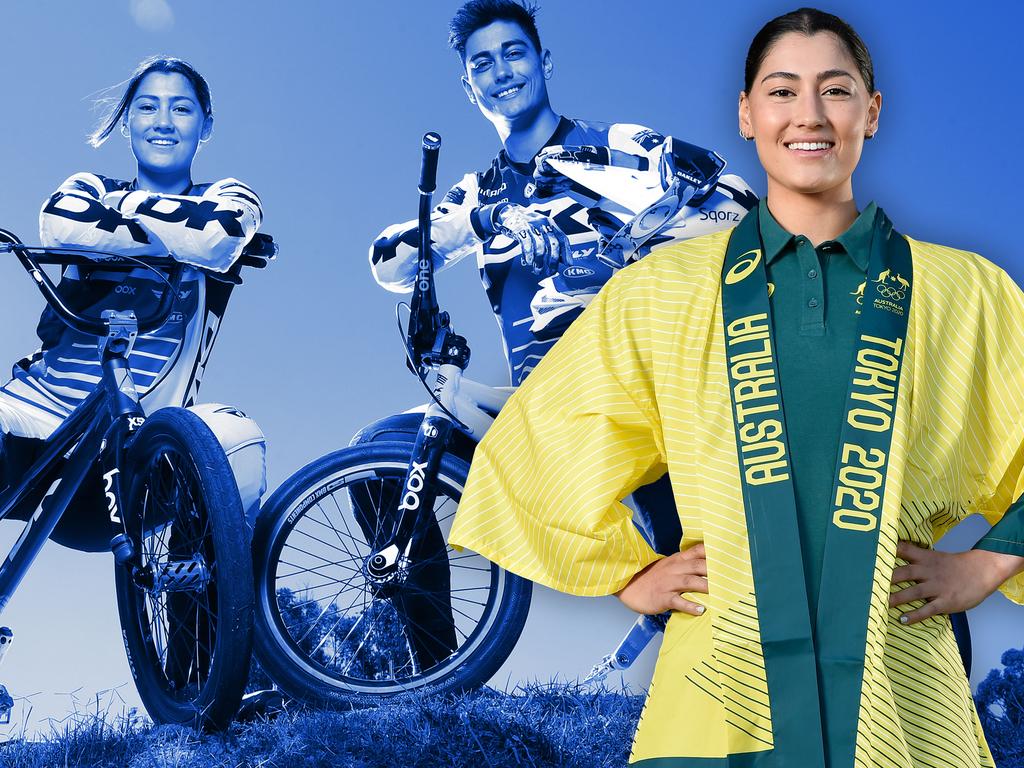
Saya Sakakibara had one goal in Tokyo: to bring home a medal.
And, for a time, that goal was well within reach.
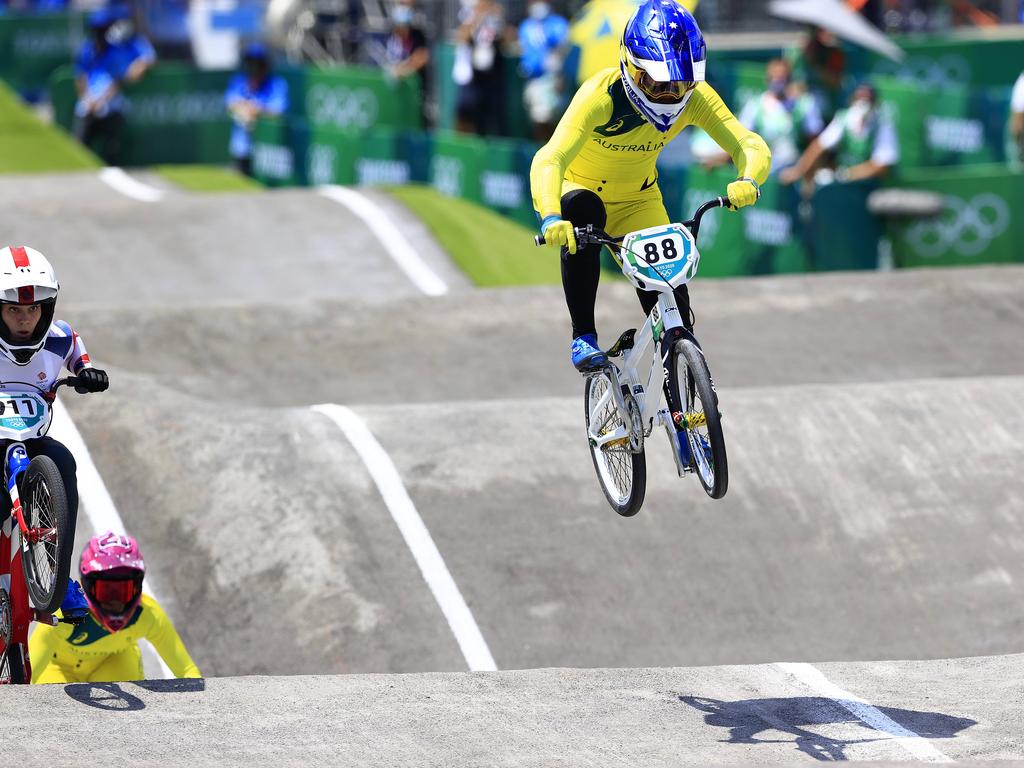
After the first two races of the Olympic semi-final, which included a win in a sub-45 second time, Sakakibara was closing in on a spot in the final. A fast start in the third run saw her lead the pack around the opening two turns. In the third straight, she battled with American Alise Willoughby, who had won Olympic silver five years earlier.
Unlike Sakakibara, Willoughby had everything to lose. A crash in the first run of the semi-final had her fighting for survival in the competition. She needed to win.
It’s in those moments desperation comes to the fore.
In an event that is over in less than a minute, there’s no time to hesitate.
Willoughby attempted to make her move. The pair collided. Both came off their bikes and hit the ground hard. Willoughby managed to get up and finish the race in seventh.
Sakakibara was left motionless on the ground.
“When I woke up and realised I was in the medical tent, I was thinking, ‘Please let this be a dream’,” she recalls. “I had no idea what had happened and it was a cruel feeling.”
After five years of hard work and determination, Sakakibara’s campaign was over in an instant.
“There’s no doubt she was up for a medal,” said Wade Bootes, the Australian Cycling Team’s Technical Director of BMX. “Seeing that get taken away from someone else’s poor riding, I just couldn’t believe it.”
*****
To fully appreciate Sakakibara’s journey to the Tokyo Olympics, one must go back to her childhood.
Saya grew up idolising her brother, Kai.
“I was the younger sister that always wanted to do the same thing as my brother,” she said.
“He loved riding his bike and he was absolutely obsessed from the moment that he set eyes on a BMX track. The fact that it was a competitive sport, it goes fast on a bike, it just ticks all his boxes and he fell in love at first sight, which is why I was drawn to that sport.”
Early on, Saya crashed three times on the same jump and gave up the sport for three months as a silent protest. But seeing her brother’s joy each time he rode convinced her to get back on the bike.
Kai and Saya left Australia when their parents’ visas expired. They ended up in Japan and the love for BMX continued. But it was not without its challenges.
“In Japan, there were no girls around my age that were racing,” she said. “I was racing the boys a lot of the time.”

The Sakakibaras eventually moved back to Australia, and the siblings’ love of BMX only grew.
Watching Kai turn professional inspired Saya.
The siblings targeted the Tokyo Olympics, and a return to the country they had once called home.
“I followed what he did and by the time I left school I had no other desire to do anything but continue on BMX,” she said.
But in February, 2020, tragedy struck.
Kai suffered a massive crash in a race in Bathurst. He suffered a traumatic brain injury and was flown from the track. What followed was months in hospital and rehabilitation that remains ongoing.
Saya spent countless hours by her brother’s bed. Waiting. Wishing. Hoping.
When thoughts eventually turned to Tokyo, the emotions were complex. The brother she had followed for her whole life – the one she had planned to represent Australia alongside – would not be there. She would take this journey alone.
“Even after I was officially selected, I was almost hesitant,” she said. “I mean he knew I was going already but I had this hesitation about sharing the news with him because I didn’t know how he would react, how he would feel, to see me living his dream.
“It was originally his dream to go to the Olympics and I had kinda taken over.”
But, even as he confronted his own battles, Kai sent constant messages of support to his sister.
His recovery also served as inspiration. From doctors initially saying he would never walk again, Kai progressed to the stage of slowly riding a bike.
He would even participate in the Paralympics torch relay.
That he retained a positive attitude throughout was a source of amazement to Saya.
“That made such a huge difference to the way I viewed the Olympics,” she said.

*****
Kai’s journey impacted Saya in ways she could not have imagined in the lead-up to Tokyo
“She had to learn quickly to organise for herself because she had Kai do everything,” Bootes said. “Saya had to step up and have more of those conversations. That’s where, as a person, Saya has developed to help co-ordinate, drive and lead things for herself.”
Flying back and forth between AusCycling’s BMX facility in Coomera on the Gold Coast and home in the Sydney suburb of Helensburgh, Saya would often spend no more than a week each month at home.
The hours were draining, the training was exhausting, but it was working.
By the time she arrived in Tokyo, Saya was riding fast. Even with a year delay because of Covid-19, she had timed her run perfectly.
But a slow start in the heats had her on the brink of elimination in the opening round.
“After that first and second race, I didn’t think I was going to make it through,” she said.
“Having that stress on top of the Olympic Games and having to use energy to redirect my thinking and get a good finish at the end was a huge rollercoaster of a day for me and I was mentally drained. Definitely, the next day, I felt it.”
After setting a new course record to book her place in the semi-finals, Saya thought she could go back to the Olympic Village satisfied in the knowledge that her first job was done.
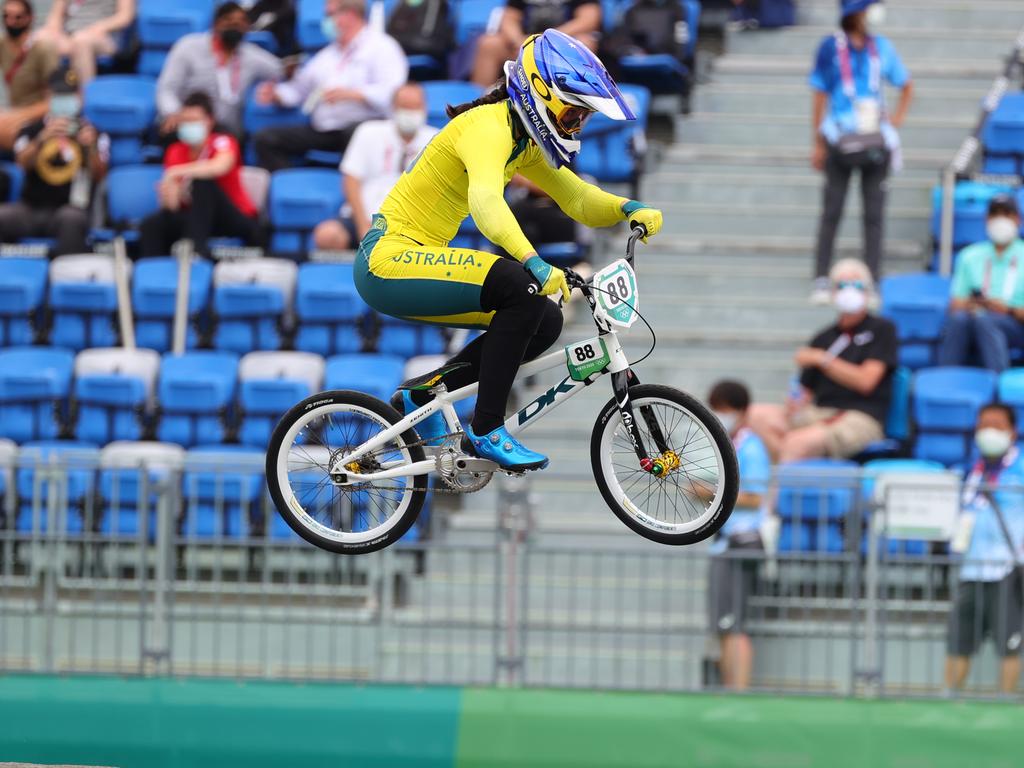
It didn’t work out that way.
She barely slept that night. She woke up fatigued, her legs shaking from the stress of the previous day. Still, her confidence was high. Setting a record tends to do that.
“Those two days of racing, my mental cue was, ‘Just go!’. Every time there was a doubt in my head, when it rained on the second day, I thought ‘It doesn’t matter, just go’.”
In the semi-final, Saya felt back to herself. She had discovered a fantastic rhythm.
“Hell yeah, this is me and I’m riding like me,” she thought.
Her speed was so good she even started to visualise herself with a medal around her neck.
The top three was within reach.
And then came the crash.
She admits her memory of the incident is hazy and, as a result, she has had to rely on watching replays, something she doesn’t particularly enjoy. But this one was important. She had to convince herself she did nothing wrong.
“The fact that it wasn’t my fault made it harder to accept than if I was to make a mistake and crash on my own,” she said.
“I don’t think I’ve really experienced a loss like this in this way or of this magnitude. So I think it has taken until now to wrap my head around it.”
Bootes vividly remembers the moment he first saw Saya after the crash. A relationship that had fostered over many months of preparation, his role had evolved from that of a high-performance director to a friend.
“We know the effort and hard work that went into it and it’s just been ripped away from you,” he said. “It’s ripped from both of us. It’s ripped from her but as a team, we’ve had a great preparation and we didn’t even get to the start line of the final even though we were winning a semi-final.”

*****
Saya suffered severe concussion symptoms as a result of her crash with Willoughby. The headaches continue to this day. While she attempted to join the World Cup circuit in Europe after Tokyo, the decision was made to return to Australia, heal and prepare for 2022.
Coming home reunited Saya with Kai, after a separation of more than four months.
Kai had made the trip to Tokyo with his mother but, due to the Covid-19 protocols around the Games, he was forced to watch Saya from the television in his grandma’s house.
The return to Australia also provided her with a chance to reflect on the emotional build-up to the Olympics, the crucial milliseconds during the Olympic semi-final and everything that followed.
“I felt that I had failed,” Sakakibara said. “It was amazing that we were able to reach these new people and share our story and it was incredible getting all these messages post-Olympics.
“All the messages were so positive. They weren’t like, ‘I’m sad for you’. They were more, ‘You did us proud, you were amazing’.
“Even though you shouldn’t base your feelings and emotions on other people’s opinions, it definitely helped to gain another perspective on what happened with the Olympics. That was a big takeaway.”
At 22, Saya is nowhere near her peak. Bootes believes she can become a dominant figure in the sport over the next few years. But the key to that is finding balance.
The rollercoaster of emotions over the last two years has no doubt taken its toll. With the massive media attention on her family in the lead up to Tokyo, Paris in 2024 presents as a fantastic opportunity for Saya to fall in love with the sport again, on her own terms.
“It’s insane that there isn’t really much of a break,” she said. “I hope Tokyo wasn’t the end for me and I hope that 2024 isn’t the end either. So I’ll keep going – and the Olympics isn’t everything – but it is a very big thing within my world.”

From coma to champion: BMX star’s comeback finds a new track

She miscarried last week – now this brave Olympian is taking on a triathlon

1000+ athletes to benefit from revolutionary $50m retirement fund

False start as Ian Thorpe prepares for wild ride in Sydney to Hobart yacht race

‘Definitely reasonable’: Teen Olympian backs social media ban
