
Record breaker: David Popovici on handling swimming’s hidden mental battles and his tactical visit to Australia
David Popovici is swimming’s next big thing. The teenage star opens up to JULIAN LINDEN about breaking the mould in his sport, the mindset he adopts against Kyle Chalmers and more.


Romanian teenager David Popovici isn’t just trying to break records, the fastest swimmer in history is also trying to break moulds in his sport.
In an era when a lot of elite swimmers are packing on muscle, covering themselves in tattoos and bragging about themselves on social media, Popovici is an aberration.
Skinny (by his own admission). But he’s not only physically different from the rest, he also thinks differently because his greatest strength is his mind.
Smarter than the average bear, the 18-year-old spends his spare time reading ancient philosophy – the letters from Epicurus and Senace, the Dialogues of Plato and Roman Emperor Marcus Aurelius’ Meditations.
He’s just completed high school and is starting university later this year – juggling the demands of being a global sporting superstar with an insatiable academic curiosity.

“I want to learn more about this chunky piece of meat in our head because if's lot more than that,” he told CODE Sports in Fukuoka, Japan.
Popovici’s scholarly approach is also paying off inside the pool.
He’s the reigning world champion in 100m and 200m freestyle – and holds the world record for the 100m. In the 200m, he’s faster than Ian Thorpe, dead-even with Michael Phelps and trailing only Paul Biedermann, whose world record was set in the now-banned supersuit.
Popovici is favoured to win the 200m gold in Japan on Tuesday before taking on Australia’s Kyle Chalmers in Thursday’s 100m.
Popovici is a happy swimmer, which is sadly much rarer than it should be. Too many of the world’s best swimmers experience mental health issues.
Thorpe and Phelps, the two swimmers Popovici is often compared to since he burst on the scene, have both been open about their battles.
Caeleb Dressel, the Olympic champion in Tokyo, is skipping the world titles after he quit the world championships midway through, needing a break.
Listen to the crowd as David Popovici comes down the home stretch en route to his new WR of 46.86 🔥🔥🔥 pic.twitter.com/psN0NDdldP
— SwimSwam Live (@SwimSwamLive) August 13, 2022
Britain’s best swimmer Adam Peaty is also missing, So is Hungary’s Kristof Milak, another of the sport’s biggest stars.
Chalmers is competing after he almost gave the sport away last year. He has courageously spoken about his mental health issues and has discovered his own solace outside of the pool. The happier he is, the faster he swims too.
It’s no wonder then that Popovici – who is tipped to be the sport’s next global superstar – wants to try to retain his sanity in a sport where success is judged by tiny fractions of seconds, not the years of hard work that goes into it.
“Trying to be a normal kid changed a while ago, but I'm just trying to stay normal and keep it simple,” he said.
“We're all humans. Some of us achieve superhuman feats while competing, but we have to not forget that we’re human. We have emotions.
“Sometimes we break down, sometimes we succeed. Sometimes it just doesn‘t go the way we want to.”
If things go as planned, the whole world will know who Popovici is this time next year when the Paris Olympics roll around.
Australians got a sneak preview of the once-in-a-generation talent at last year’s short-course world championships in Melbourne.
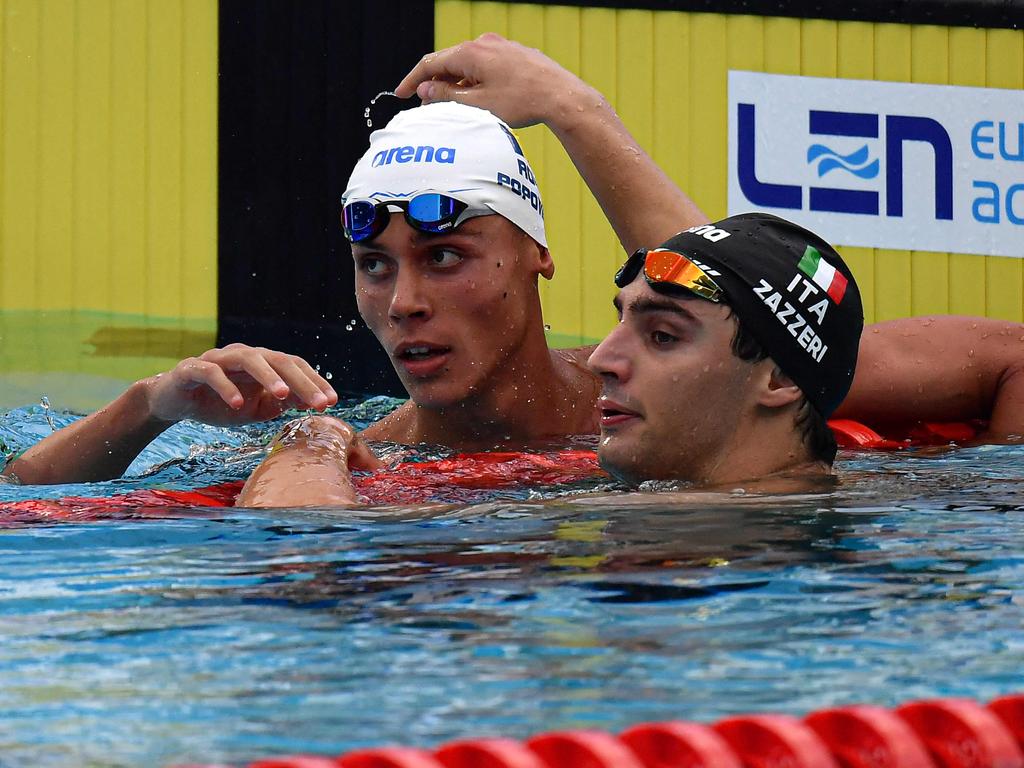
He didn’t win any gold medals but that was part of a master plan devised by long-term coach Adrian Radulescu, who has a PhD in sports science and a broader interest in humanities that he’s instilled in his brightest pupil.
Short-course swimming (held in 25-metre pools) is completely different to long course swimming (held in 50-metre pools) because competitors are allowed to swim the first 15m of each lap under water.
In short-course, that equates to 60 per cent of a race, which gives a huge advantage to bigger swimmers who can use strength to pull through the water. But it disadvantages lighter, technical swimmers like Popovici who have more speed above the water.
He already knew that before he went to Australia but thought it would be good to be reminded what defeat tastes like.
“There are only two ways of competing. You either win or you learn something,” he said.
“If you only ever win, at some point you're going to get extremely bored and I don’t want to get bored with this sport.
“I want to keep the fun. I want to keep the tension between me and my competitors. I really enjoyed Melbourne. It was a very nice meet for me, one of the best I've ever had because I felt good and it was a little humbling knowing that I’m really not the best in everything I try and compete in.”

Popovici’s view of himself is also telling.
Recently, his swimwear sponsor approached him about their plans to promote his brand in the future. But they wanted something unique. And they got it.
“They asked me to choose an animal that represents me. And so me and my girlfriend, actually it was more her than me, came up with the idea of the dragonfly,” he said.
“I think I identify myself with the dragonfly because it floats above the water. It doesn't swim, it doesn’t fly, it just glides above the water, and is a very smart insect.
“So I try to think of myself a little bit in that way too.”

‘Unrecognised’: Swimming vies for love – with a swipe at athletics

Titmus sought out Barty for advice on early retirement

Thorpey’s back in the water for Sydney-Hobart adventure

Dean Boxall’s three words that sparked ‘bonkers’ record blitz

Digging deep: Swim coach’s mission to put Rocky on Olympic map
