
Australian Open 2023: Female tennis coaches are poorly represented on pro circuit and confront challenges rarely faced by male counterparts
No seed in the Australian Open women’s draw has a female coach. LINDA PEARCE investigates the systemic issues at play.

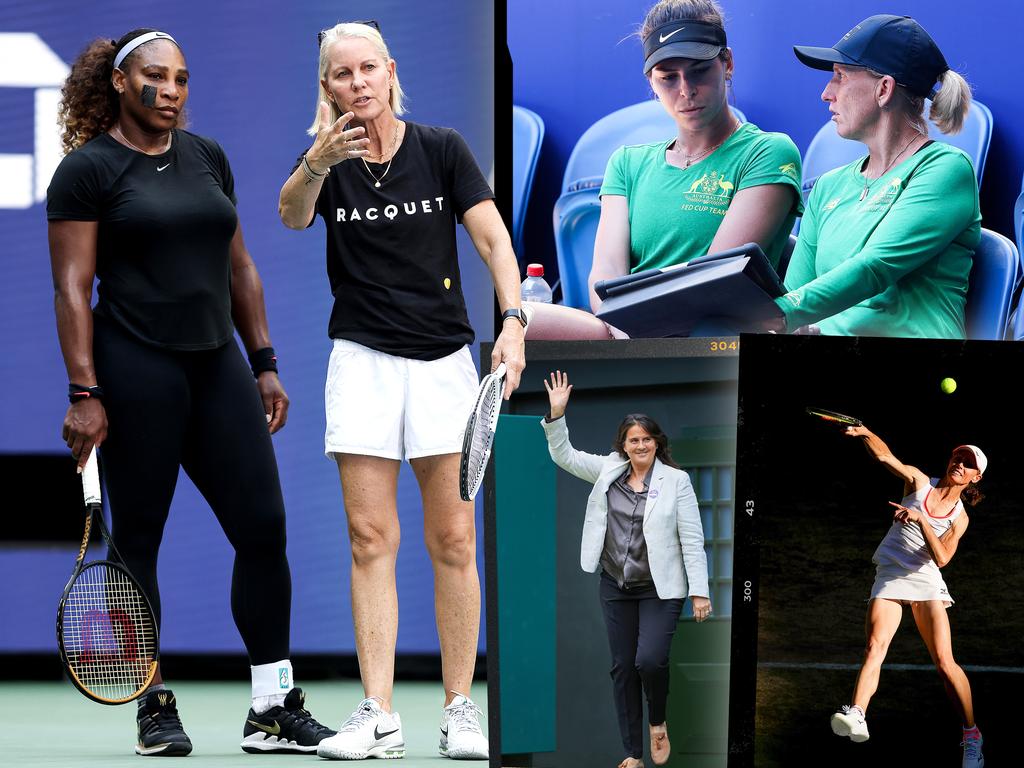
As the great Serena Williams was preparing to take her farewell bow in New York, Rennae Stubbs, her temporary “on-court advisor” (as the role was described on Good Morning America), was chatting with a fellow Australian analyst for broadcaster ESPN.
“Darren Cahill said to me at the US Open, ‘Geez, if you don’t get a permanent great (coaching) gig after this, I don’t know what to say,’’ recalls Stubbs, a six-time grand slam doubles champion who has previously worked with the likes of Karolina Pliskova, Genie Bouchard and Sam Stosur.
“I didn’t think me making a difference with Serena was going to be like, ‘Oh … this is definitely going to get me a job’. My motivation was purely, ‘How can I help my friend finish her career the way that I feel like she should?’ And it worked out.
“But it’s a perfect example of not even getting a call from an agent to even inquire what my plans were. There was nothing, and that’s so indicative of what I think a lot of female coaches go through.
“We’re just not on the mind of agents and players.”
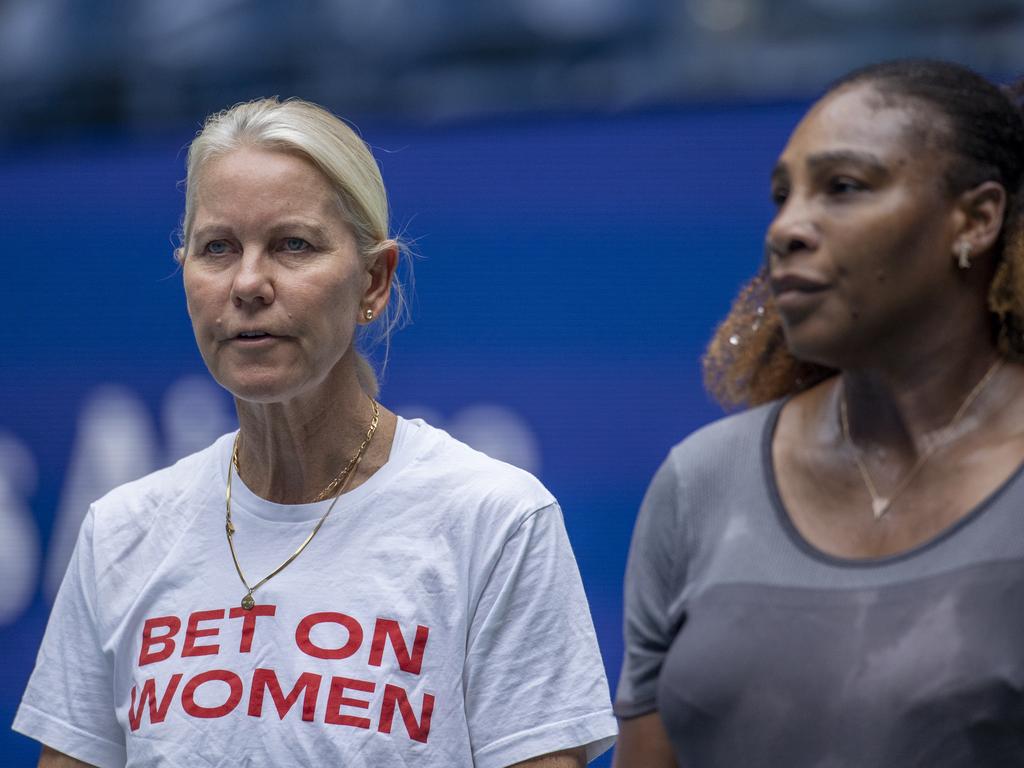
While Stubbs was a highly visible presence in the Flushing Meadows player box for Williams’ win over Danka Kovinic, second seed Anett Kontaveit and emotional swan song against Ajla Tomljanovic, a scroll through the WTA website clearly shows something else: just how rare are elite women coaches in tennis.
This time two years ago, there were two among the top 20: Elise Tamaëla (guiding No.10 Kiki Bertens) and Conchita Martinez (with then No.15 Garbine Muguruza). The latter partnership endures, despite Muguruza’s dip to 55th, but there will be no seed in the Australian Open women’s draw with a female coach.
Among just a handful in double-figures, including No.61 Sara Sorribes-Tormo (Silvia Soler Espinosa), the highest is 35th-ranked Swiss Jil Teichmann (Arantxa Parra Santonja), while 2022 Roland Garros champion Barbora Krejikova thrived earlier in her career under the late Jana Novotna, Madison Keys had a lengthy association with former No.1 Lindsay Davenport and Jelena Ostapenko won the 2017 French title with Annabel Medina Garrigues in her corner.
Telling, too, is that of the 101 WTA coaches profiled, only 13 — including Aussies Nicole Pratt, Stubbs, Nicole Kriz and Sarah Stone — are women.

Oft-cited barriers include traditionally mum-skewed family considerations given the demanding travel commitment of typically 35-plus weeks per year, and the financial saving in having a male coach more likely to double as a hitting partner, especially for the more fiscally-challenged.
Yet as much as tennis has earned pin-up status for its gender parity on grand slam prizemoney, for example, and is home to seven of the world’s highest paid female athletes in 2022, according to the annual Forbes rich list, coaching is one of the areas which remains heavily male-dominated.
Thus, in November, the WTA announced a targeted Coach Inclusion Program geared toward attracting, developing and retaining female tennis coaches to diversify and broaden the talent pool, by breaking down barriers and “providing opportunities for women looking to enter coaching at the professional level”.

Not everyone is convinced.
Tennis Australia, which collaborated conceptually with the WTA on the initiative, will roll out a similar three-step program in 2024, having two years ago appointed Pratt — long-time mentor to Daria Saville (nee Gavrilova) and Storm Hunter (nee Sanders), among others — to the newly-created role of TA women’s coach lead and national women’s teams coach as part of its Women and Girls Strategy.
To satisfy federal government funding requirements, the number of female coaches nationally must rise from its current 26 per cent to 35 per cent by June, 2024, with increases sought in all the various metrics among the pathway. In Victoria, for instance, a meagre 15 per cent of club head coaches are women.
It has been, Pratt admits, a bigger job than she expected.
“Definitely.’’

*****
Oh, the shock. The horror. Back in 2014, the tennis world gasped when proud feminist Andy Murray, son of a female coach, appointed Amelie Mauresmo to head his team for both emotional and performance-related reasons.
Scorn and ridicule from the unsupportive and incredulous was mixed with pride and applause from those hopeful it would usher in broader attitudinal change.
It didn’t.
Mauresmo is now the Roland Garros tournament director, after helping French compatriot Lucas Pouille to reach the semis at Melbourne Park during their stint in 2019-20, but is still one of few exceptions to an obstinately enduring rule.
More common, slightly, is mums coaching their sons (see Canada’s world No.18 Denis Shapovalov, whose mother Tessa remains heavily involved, and Uzbekistan veteran Denis Istomin).

But, let’s be honest: if women are still so reluctant to hire women, then it seems a forlorn expectation that men will.
“It’s not ‘normal’ - but it should be,” says Hunter, who completed her Level One accreditation in 2018 and would consider coaching on tour, post-playing, if personal circumstances (eg children) permit.
“Or it’s only ‘normal’, or acceptable, if it’s ‘the mum’ coaching. Whereas if it’s actually a ‘coach’ coming into the team it’s questioned a little bit.”
As to why there are a couple more women now, but still so few, Hunter — currently working with WA’s Scott Webster, but also still guided by Pratt — cites among the reasons a lack of self-belief and shortage of role models and examples.
“Honestly, I think a lot of it is just that’s the way it’s been and female coaches maybe don’t think they belong at that level because there’s one or two and they always seem to be challenged or under the microscope,” she continues.

“Maybe there’s just not enough out there, so when, as a player, you’re trying to find a coach, 90 or 95 per cent are male, so your chances of hiring a female coach are slim. Not as many options.’’
In August, Fed Cup captain Alicia Molik, Casey Dellacqua, Bryanne Stewart Crabb and former world doubles No.1 Cara Black were among the graduates of TA’s high performance coaching course, the latest in its suite of scholarship opportunities.
Every little bit helps, considering that Black was mistaken for being her US charge Kaitlyn Christian’s sister by a rival player’s mum/coach one year at the Adelaide International given how few women coaches were in the house.
A few years earlier, Pratt was constantly assumed when travelling with Hunter to be the player’s mother, for why else would she be there?

“Seriously, that was every week. Just in general. Players, other coaches, parents. I had to say, ‘Yeah, we look alike a little bit but, no, I’m (the) coach’,’’ Pratt says.
“And then if they asked me my name, they would realise, but I did get that one quite a lot.’’
No discrimination out on tour, though, Pratt says, given the former world No.35 has always found it to be an inclusive space.
“And I wouldn’t say discriminated against here in Australia, but (I’ve) potentially not had the same opportunity as ‘others’. It’s more just being marginalised a little bit.’’

*****
Black, a 10-time major winner, grew up in Zimbabwe as the youngest of former 1950s Wimbledon regular Don Black and his ballerina wife Velia’s three children. Brothers Byron and Wayne famously toppled Australia in a 1998 Davis Cup tie in Mildura, while Cara spent 163 weeks as the world No.1 in doubles.
The family farm had four grass and one hard court, but Don Black was old-school enough to declare tennis was not a sport for girls. That only changed when Cara was 10, being coached by her mum, and Wayne left for the US.
Eventually, all three Black siblings would, like their father, wear Wimbledon white.
“Before that I used to help my mum coach the littlies on a Saturday morning and she would pay me, and then I would book a lesson with my dad on the Saturday morning and pay him the $30!’’ Black recalls.
“So he coached, my mum coached, and then when I retired … it wasn’t like something I knew I was gonna do; it was more I just fell into it.’’

By then, she was married to former AFL player Brett Stephens, whose fitness clients on the tennis tour included not just his wife but Pete Sampras and Mark Philippoussis. The pair share sons Lachlan, 10, and Jordan, 6.
After an initially casual but gradually more formal – and lengthy – stint helping Arina Rodionova, Black now works with local juniors on the family’s Mornington Peninsula court, as well as a handful of touring pros. The latter remotely, mostly, other than during the Australian summer and a mid-year catch-up at Wimbledon, where she won four championships including a mixed with brother Wayne.
“The biggest thing is the family issue, and that’s why I’m not full-time on the road. I would like to do more weeks, definitely, but for me it’s also a factor of I’ve already done that whole travel situation as well, being a former player, and I know what a grind it is,’’ Cara says.
“It sounds like a glamorous lifestyle, but it’s really gruelling.’’

Without resorting to reverse stereotypes, Black learned first-hand the benefit of key female mentors and coaches, notably Daria Kopsic and Kathy Rinaldi, and which included differences in communication styles and sensitivity levels, “and those types of things I think that men don’t get sometimes”.
“Sometimes the harshness of the approach — and I say this because I know my brothers, they can be just brutal, and they were with me! It was like, ‘Just hit the ball!’. There was no care in that.
“And just speaking from my own experience, I had a couple of male coaches that I didn’t connect with, at all, and I wasn’t in a comfortable space because I just felt that there wasn’t that time put into the relationship in terms of women sometimes needing to talk more, whereas men don’t need that as much.
“We need to be nurtured more in situations … or not be afraid to express those feelings if you’re nervous, or you’re feeling a bit vulnerable, whereas guys kind of hold that all in a bit more, I think, and deal with it differently.’’

Black notes the high dropout rate among teenage girls, particularly, and believes more women coaches would help during those “tricky” years, especially, while Pratt cites the direct correlation between higher retention rates of girls at clubs with more women coaches.
So it is that the five pillars — competition, participation, talent ID, community leadership and coaching — are so closely intertwined.
Horse, cart.
Chicken, egg.
Less about hitting tennis balls, and more about what’s experienced, enjoyed, and witnessed.
“At the end of the day, if young girls do not see women then why would they ever be interested in coaching, because they don’t see it, and they don’t think it’s possible,’’ Pratt says. “So it’s a cycle, and I think starting with more women coaches is key.’’

*****
A 2020 Flinders University study identified six impediments to women becoming tennis coaches:
- Gendered profession (male-dominated appointments, gendered appointments, lack of respect),
- Job requirements (unfavourable hours, work/life conflict, burnout),
- Stability (financial security, viable long-term career),
- Societal barriers (stereotypes, gender norms),
- Career advancement (development opportunities, experience),
- Lack of support (mentoring, networking).
“The challenges and barriers are real,’’ says Pratt, a mother of twins. “A lot of it’s also a lack of education of the consumer, and the stereotypes.
“As a woman coach, ‘Oh, you’ll be really good with young kids. And you’ll be really good with the young girls’. And what happens is that women coaches end up getting pigeonholed and then there’s a burnout because that’s all they end up doing.
“It’s quite complex to solve.. I thought, naive of me, I’d just go, ‘Let’s attract, let’s develop and let’s retain’. The three core things. And it sounds good. But the reality is that it’s quite complex, and the studies prove that there’s four different layers.’’
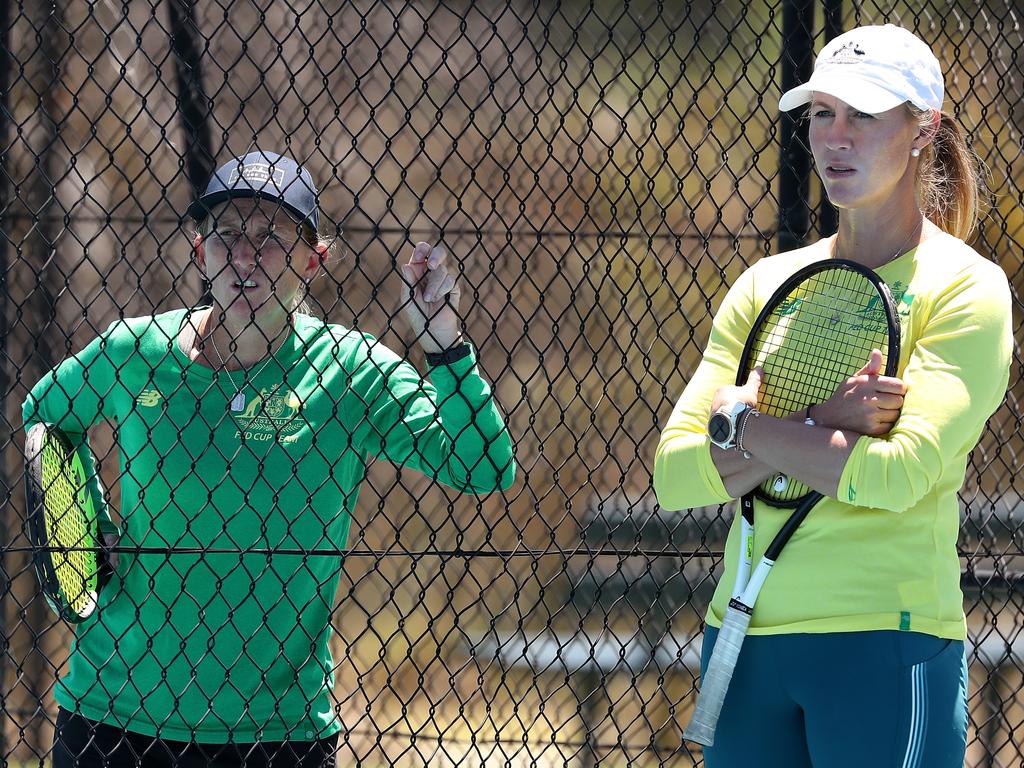
Then there’s the more anecdotal. Socio-cultural factors. Or what Pratt explains as women generally tending to be harder self-markers despite comparable knowledge and competence, among other ingrained characteristics.
“So from a young age boys are developed to be brave and, to a certain degree, girls are expected to be perfect,” she continues. “So that’s the big, big thing but that is part of the complexity of change, and, yeah, it’s gonna take quite a while to get the change we need.’’
One part of the solution may be a form of board-style gender-based quotas in which the states could be told that affiliation with the governing body requires a minimum percentage of diversity in the coaching workforce. A carrot/stick rewards system for funding, perhaps, if that’s what it takes.
While Pratt still has conversations with parents who don’t want their son working with a female, she is fortunate that, as an ex-pro, her bona fides are questioned less than some of her female peers - but also acutely aware that men are not judged by the same standards.

“When a parent sees, say, John, who’s hitting with, let’s say, a young boy, the level of what they’re playing is the level at which parents see them as a coach,’’ Pratt says.
“The way that you hit and the way that you coach are two entirely different things, but there is this bias towards, ‘Oh, you’re a good coach if you play well’, and so in a way with the women it’s almost like a prerequisite if you want to work in high performance that you have to have played at a level and I don’t agree with that.
“I see that more as a bonus if you did because you can obviously bring those experiences, but it’s still stereotypical, and I call it the double-standard.’’
As is the ceiling that Mauresmo cracked — even though Murray’s three singles majors all came under male coaches — with Pratt certain the double-standard permeates the pro ranks, too.
“With women high performance coaches it’s, ‘Oh you’ll be great with the women, but not considered to work with men’. Yet when men are coaching men, and then they move to women, no one says anything. It’s not the same set of rules, and it’s actually not the glass ceiling in tennis for me. I call it the glass wall.
“Amelie Mauresmo, for a short period of time, she broke down that glass wall.’’

That is, the one between courts.
The one dividing women coaching women and men coaching, well, anyone.
Right next door.
Pratt wants it shattered, and has already decreed that all the scholarship coaches at TA’s National Academy in Brisbane will work equally with both sexes.
Enough of the stereotype. A shift in delivery. But challenges still ahead.
So, while noting that comparable numbers are far worse, even “scary”, in some other sports, in tennis will there ever be a 50-50 coaching split?
“I’d like to think so,’’ Pratt says. “One day we’ll get there.’’

*****
Another contributor to the glacial pace of change is the coach/hitting partner double-up that Stubbs believes can be counter-productive because, by trying to economise, it potentially compromises the quality of both.
There is no financial excuse for the top 20 to combine the roles, she insists, yet agrees with Black that it can be appealing, often necessary, for those at the less-pointy end struggling to just pay the bills.
“At the same time, I don’t really like the girls hitting with guys all the time either,’’ Black says. “It’s such a different ball. So if you can have a women that can do it all, that’s perfect.’’

Pratt hopes increased prize money is shifting the dial, as is the fact that more tournaments are providing practice partners, and that the peak period when few women on tour wanted to hit with each other has passed.
“But what I’ve also realised is that, in my book, if you’re not with the player and behind the player, if you’re hitting, you’re not coaching. You’re not as effective.
“There’s a time and a place to be down the other end, to receive their ball, etc, but I say to all coaches, ‘If I see you every day and you’re hitting, you’re not coaching, so start to spend more time down with your player’.’’
Pratt’s other push is to modernise and recreate the coaching role altogether.
“Co-coaching is the future,’’ she says, describing a model in which two people with a shared trust and philosophy, similar beliefs but perhaps contrasting approaches, keep things fresh for the athlete and manageable for the coach.
“I think that just opens up a whole world of possibility for women coaches that wasn’t there before and it also creates the opportunity for all coaches not to endure burnout, because there are so many broken relationships because of the travel and the weeks on end and it can get stale.
“It doesn’t have to be that way, but we need people to see it differently..’’

*****
By the time Australia’s second-ranked doubles player, Ellen Perez, approached Stubbs in New York about the possibility of working together, it was too late.
After fielding zero expressions of interest from agents, the 51-year-old had decided to shelve her coaching aspirations for 12 months to host a weekday sports show on Amazon Prime Video from New York, while continuing her ESPN duties for the Wimbledon and Australian/US Open fortnights.
Stubbs had offered to help out Williams, following a dismal loss to Emma Raducanu in Cincinnati in August, persuading her friend to take more of a micro than macro approach to her final stretch before retirement – oops, “evolution’’ – and build her confidence through, for instance, more practice sets.
“Obviously I feel good about what I was able to help Serena with, getting her in a better space,’’ Stubbs says. “Other than winning the tournament, that was as good as she was going to get out of that situation — having played, like, six matches in a year. It was impossible.’’
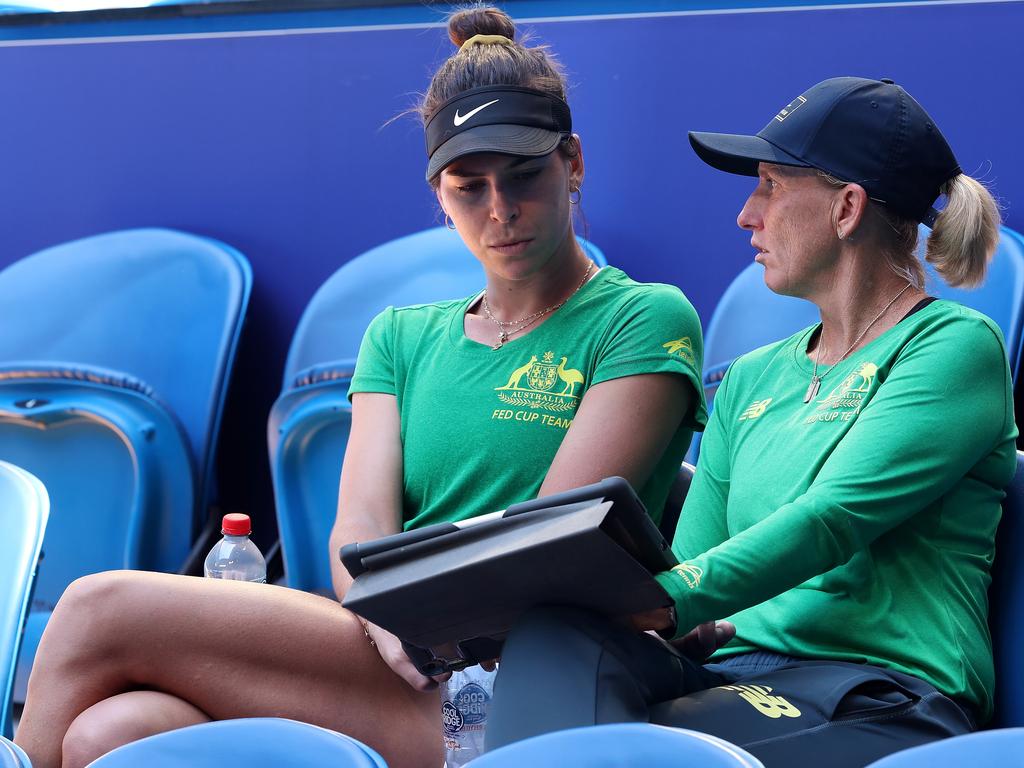
Yet, having spent time in her latter on-court years working with Martinez, she still questions why the barriers to women coaches remain so immovable and why, almost 10 years after the Murray-Mauresmo moment, so little has changed.
“Maybe it’s just being afraid to pull the trigger. I don’t know. That’s only a question that can be answered by the players, really, and it’s a great one to bring up in a press conference: have you ever contemplated working with a female coach? But nobody asks the guys and, quite frankly, nobody asks the women players that either.
“It doesn’t make any sense to me. I know women that would be fantastic. I mean, I would love to work with a guy, too. There’s no question I think I could make certain guys that I would love to work with, better.’’
Such as a younger version of Grigor Dimitrov. Shapovalov now.
“I like players who are different, A little bit fiery. I was an emotional player myself. I think of Shapovalov because I think he’s a little bit crazy, and he had his mum as a coach, as well, so he’s certainly not opposed to a female.
“Tsitsipas? Yes. But good luck getting him away from the dad. That’s half his problem.’’
The 2020 Australian Open champion Sofia Kenin and Greek world No.6 Maria Sakkari are among those who appeal on the WTA Tour, but Stubbs claims another key element in the enduring boys’ club is the influence of (mostly male) player agents.

’’You’ve got to be in the pocket of the agents,” she says. “This is where the issue lives. They have five or six or seven male coaches that they cycle around to their players. All you have to do is say ‘Who’s your agent?’ and then you can start putting f — ing two and two together.’’
None of which she sees changing any time soon.
“No, sadly, I don’t. And I think some of these women are missing out on that experience and that emotional perspective. There’s still some female coaches out there. Just in my opinion, not enough. Nowhere near enough.’’
And so, back in August, once the lights dimmed on Arthur Ashe Stadium and the curtain fell on Williams’ 23-slam career, Stubbs found herself back in front of the cameras but on a different path.
Still, her US Open visibility, coming as it did with the very public endorsement of one of the game’s all-time greats, of any gender, showed a welcome faith in the sisterhood that Pratt hopes one day just might catch on.

‘I want to be happy’: How nine-year grind nearly broke Aussie star

Aus Open comeback ramps up as Kyrgios books key-lead up event

‘A bit scared’: Tennis star opens up on pregnancy journey, future plans

Williams set for Australian Open warm-up event return

How Davis Cup can revive Demon after US Open disaster
