
Ash Barty and Pat Rafter are cut from the same cloth as all-conquering Aussie favourites
Fist pumping at the footy. Self-deprecation over scandal. Trophies repurposed into furniture. There’s just something very relatable, very Rafter-esque about Ash Barty.


Back when Ash Barty was a toddler in suburban Ipswich, another Queenslander already rated among Australia’s most popular sporting figures was asked about his relationship with the American great Pete Sampras. “We’re not the best of mates,’’ Pat Rafter said in the months before winning his second US Open title in 1998. “I wouldn’t go out for a beer with him, put it that way.’’
From one of the game’s good blokes, known for the “sorry, mate” apology after an errant ball toss and for putting his credit card on the bar of the famous Dog & Fox in Wimbledon village on the night of his devastating 2001 finals loss to Goran Ivanisevic, it was difficult to imagine a more cutting rebuke. Have no doubt, though, that Rafter would be happy to have a few beers with Barty, and be equally comfortable with a dress code of shorts and thongs.
Con Stavros, sports marketing expert and Associate Professor of Marketing at RMIT, sees the humble, 25-year-old Barty holding a similar place to Rafter in the hearts of the Australian public. Stavros calls the concept of what works in the Australian market “likability and similarity”. It matters not just that you win, but the way you do it. Not just who you are, but how relatable.
“In Australia, it’s a bit like whether you’d want to have a drink with them at the pub, and Ash just hits that mark extraordinarily well,’’ says Stavros. “Pat Rafter is my equivalent. The way he spoke he just seemed to be the all-Aussie guy, never seemed to get too infatuated with himself, and Ash is never going to talk about herself in the third person or anything like that. So she’s got that approachability, she’s down-to-earth.
“I play tennis, and she seems like the kind of person I might meet down at the club and have a hit with. If you turned up one day, I’d almost imagine that I could walk up and say ‘hey, can I hit a few balls?’, and she’d be like ‘yeah, no problem’, and you can’t think of many athletes that you could do that with. Or you could walk up and say ‘we’re having a barbie at home, do you want to come around?’. There’s nothing fake about her. She just seems very authentic, and the Australian market loves that kind of stuff.’’

Cue the vision from last year’s AFL qualifying final between her beloved Richmond and Brisbane at the Gabba, Barty had sat out the balance of the WTA season when it resumed in August to stay at home with her tight-knit family, walk her dogs and become women‘s club champion at her local Brookwater, where partner Garry Kissick is a teaching pro. The image of a T-shirt-wearing Barty out of her seat, frothy raised, fist pumping, went viral.
“That just plays to the likability scenario – ‘I sit there with a beer in my hand at the football, she sits there with a beer in her hand at the football. She’s one of us’,’’ says Stavros. “It doesn’t matter that she’s won more than $20 million in prize money. You don’t feel like you’re going to walk out to the carpark and she’ll get in her Ferrari while I get in my Mazda … although I’m sure she’s got a decent car.’’
One would think so given Jaguar is among a dozen corporate sponsors. Others range from the tennis-related (Fila, Head) to endorsements for the iconic Aussie brand Vegemite and Banana Boat sunscreen, streaming service Kayo, watchmaker Rado and Paul Hogan’s alma mater, Tourism Australia. Such is the everywoman breadth of her appeal from those aged eight to 80 and the spoils that come with being the most searched female athlete in the land. A recent study by Google Data placed Barty ahead of outspoken Opal Liz Cambage at No.2, with cricketer Ellyse Perry and Matildas captain Sam Kerr next.
Even Barty’s rivals are unusually united in their praise. Respected journalist Courtney Nguyen, aka the ‘WTA Insider’, points out that the winner of 13 career singles titles is not the only beloved player on the women’s tour. Dual Wimbledon champion Petra Kvitova is another inside the top 10, and Simona Halep is also in the conversation, with Maria Sakkari and Ons Jabeur among the more junior cohort about whom a bad word is rarely heard. There are different challenges at the pointy end though; a finer line to walk.
“When you’re not a top player it’s very easy to be friends with everybody. But when you're kinda taking their lunch money every week, resentments can build,’’ says Nguyen. “What sets Ash apart on the tour is she handles her success humbly and with lots of sportsmanship. She’s just a normal girl among the rest of the locker room.
“She doesn’t have that vibe of superiority that can come – whether intentional or not – with being the queen of the castle. When you’re No.1 for over a year, you’re gonna have a natural swagger, you’re gonna have a natural confidence that can rub people the wrong way, through no fault of your own. But whether she’s ranked No.1 or ranked No.40, she still talks to the exact same players the exact same way, shakes hands, looks you straight in the eye, and I think they all really, really appreciate that.’’
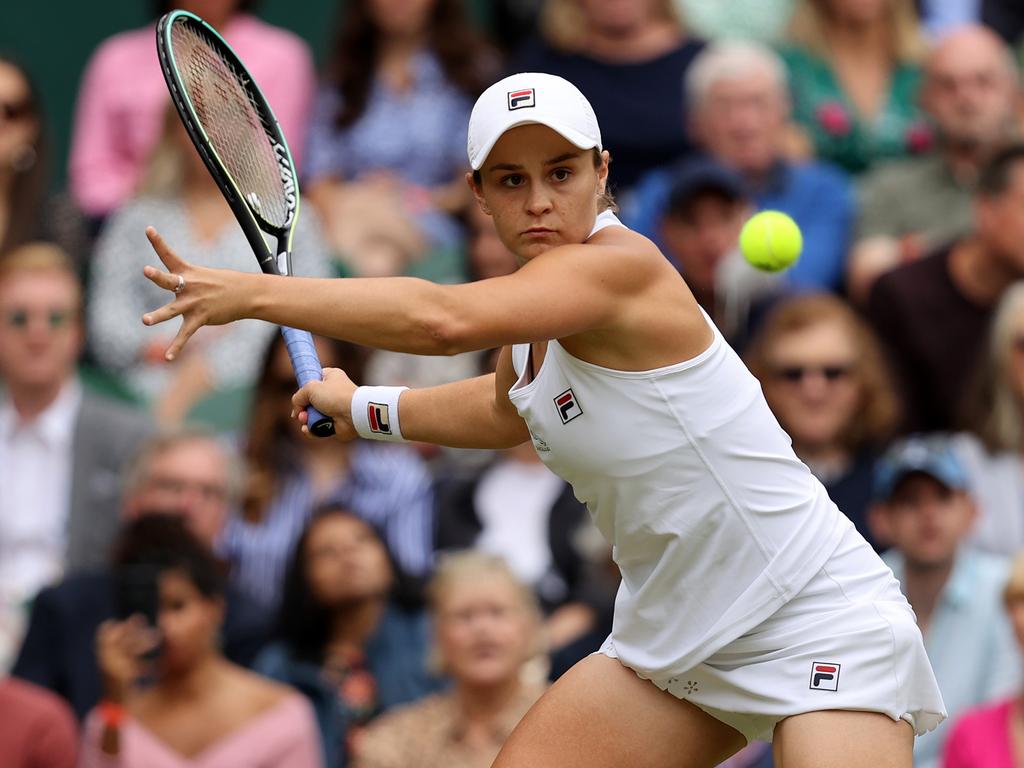
Consider this peer example. American Shelby Rogers had been 0-5 against Barty, which meant that the upset result at this year’s US Open was not quite in the “nobody beats Vitas Gerulaitis 17 times in a row” category once he finally defeated his nemesis Jimmy Connors, but significant nonetheless. After a warm embrace and exchange at the net, a gracious Barty left Arthur Ashe Stadium with a smile and a clap for the crowd, raising her arms in appreciation as commentator Mary Carillo enthused “look at Ash, how smooth is Ash?’’.
When Rogers spoke later about the pair’s relationship, she described Barty as “one of the most professional people I've ever met in my life, as well as a good person, a funny individual. Just refreshing to see. She’s super down-to-earth. I mean, she is one of my favourite people … She’s always encouraging to everybody around her. She brings up the energy (level) wherever she goes. I can’t say how much respect I have for her and what a great representative she is for women’s tennis.’’
Particularly this season. As a homebody who had been on the road since March. Dealt with multiple injuries. Still won five tournaments, including Wimbledon. Remained No.1 throughout. Preferred to “take the piss” out of her marathon journey to the US in the first place and the challenges that followed rather than complain. “I mean, this girl is everything every player wants to be,’’ Rogers continued. “Honestly, I could do this for another 20 minutes. Yeah, she's one of my favourite people, so … any time I get to give her a hug, I try to take the moment.’’

Nguyen recalls an encounter that was impressive in a different way; a superhero act that was all about the costume change. The day after Barty had thrashed an overwhelmed Marketa Vondrousova in the 2019 Roland Garros final, she returned on-site to complete her media commitments and the mandatory champions’ photoshoot in front of the tournament logo modelled in red clay.
You might remember the image. Little black dress. A low heel. Hair scraped back in a slight up-do. Subtle makeup. And the ultimate accessory: the Coupe Suzanne Lenglen. Nguyen, who had an interview booked straight afterwards, arranged to meet Barty in the player restaurant and, after a quick detour to collect some recording equipment, was surprised by what she saw just six or seven minutes later.
“Ash rolls up and she’s already in her shorts and tank top, hair back in the proper Ash ponytail, with her sneakers not laced up, and she just flops down. That was Wonder Woman levels of speed in changing clothes. It was very Ash.’’
Herself, that is. Casual being her preferred state. Still. “I was joking with my friends that of course Ash would win the one version of Wimbledon where there’s no Champion’s
Dinner. No fancy dinner, no dress and heels, no hullabaloo. She just got to win and walk away.’’

It led, after a much-needed break, to the Olympics, which Nick Kyrgios has twice found a reason to skip. But in Tokyo Barty added a mixed doubles bronze medal to a trophy cabinet that might have included copious junior mementos had so many not been recycled for the joy of the less decorated, while others have been repurposed as vases by her sisters Ali and Sara and mum Josie. Crystal vase, anyone?
In a column in 2018, the Barty siblings spoke of never seeing Ash rebuff a request for a selfie from a fan on the street or departing from what, so admirably, is the family way. “What we’re most proud of is the way she carries herself, the person she’s become through everything she’s experienced and the fact that none of it has changed her. It’s a huge amount of pressure to deal with and it’s so important when you’re a role model for kids, which all these athletes are. But she carries herself with such humility and she’s so gracious and generous all the time, and that is the most important thing.’’
Indeed, a Barty scandal is about as likely as a Bernard Tomic renaissance. Just not happening. She was vaccinated in April. Has never suffered from foot-in-mouth disease. Stavros considers her a “super safe bet” for brands keen to associate with her squeaky clean name (the f-bomb dropped after winning her maiden major merely adding an endearing unscripted touch). And if marketing is apparently “part art, part gut feel, and a bit of science as well’’, the experienced academic would tell a client planning to research consumer perceptions of Barty to save their money. No mystery there. At 25, she is also a long-term prospect. Think Rafter and Bonds.
The dog and coffee fanatic still lives in humble Springfield, rather than a tax haven such as Monte Carlo, Bermuda or the Bahamas. Perhaps the closest she has come to controversy was being accused of trying to deflect tough questions in the wake of her 2020 Australian Open semi-final loss to Sofia Kenin by bringing her baby niece into the media room. When seen unmasked at a Melbourne supermarket in January in an accidental breach of public health requirements, she promptly apologised, promising to “be better next time’’.
“If as bad as it gets is doing one thing that everyone has done, which is walk into a shop and realise ‘oh crap, I don’t have a mask with me, whoops’, or bringing your niece into a press conference, I think you’re doing OK,’’ laughs Nguyen. “If that’s all that people can latch onto in this age of social media, where everything gets picked apart and criticised, you are ahead of the curve, 100 per cent.’’

Any minor gripes are the domain of what Nguyen calls the “pockets of fandom” with a thirst for the type of women’s tennis dramas that its top-ranked player resolutely avoids. Indeed, the WTA staffer equates Barty’s unflappable interview style with repetitions of her signature backhand slice. “It’s just off-pacing, just refusing to let anybody drag her into those things. She has a way of keeping the conversation on her terms, and her terms are to keep things positive-to-neutral; it’s not to go negative.’’ To that end, the all-court star improvises, and anticipates, much like when she plays. She is prepared, in control, and so much more confident than the troubled teen who in 2014 took an extended break from the sport. Then played cricket. As you do.
“From a tennis point of view I think being able to see someone achieve what she‘s achieved during her pretty young career is incredible,’’ says her former Fed Cup teammate and predecessor as local No.1, Sam Stosur. ”And also to have had the courage to stop, step away and be OK with that, and not feel the pressure to just keep doing something that she didn’t want to at that time. I never really thought she’d play again; let alone be able to do what she has.’’
Then there is her exquisitely varied game, which is a key point of difference amid a sea of first strike rivals such as Naomi Osaka and Aryna Sabalenka. The rare, tricky slice that is rated by tennis identity Paul McNamee as her most effective weapon was one shared by Evonne Goolagong Cawley, the Indigenous idol, friend and mentor from a different era with whom Barty is often compared. “No one could have the grace of Evonne, but other than that they’re very similar in a way, because they both volley very well, have a beautiful sliced backhand, they’re both very natural, lovely people with the similar (Indigenous) background, etc, etc,’’ says McNamee. “But there’s only one Evonne, and there’s only one Ash.’’

The latter, he adds, is a throwback to the old-fashioned Aussie stereotype of a laid-back, relaxed and welcoming nation that McNamee suggests no longer applies.
“I think she represents the Australia that people long for,’’ he says. “This is not the Australia that it used to be – with the fair go, the good heart, the whole thing. Ash reflects that, and I think people associate her with the Australia that we wish it to be.’’
Which sounds like a potential debate to be had over a cold beverage or two, pandemic permitting, eventually.
*****
Subscribe now for full access to CODE on website and app: Download on the App Store or Google Play.
And don’t forget to check out CODE’s weekly podcast with Adam Peacock and Georgie Parker: CODE Words

‘Very lonely mission’: The price of being a teen tennis star

Federer to return to Aus Open for ‘battle of the World No.1s’

Ultimate wildcard: Mystery still surrounds Kyrgios AO plans

Titmus sought out Barty for advice on early retirement

Demon’s vow after taking out top tennis honour for fourth time
